Saturday, January 12, 2008

The Kite Runner -- Khaled Hosseini

There is only one way that I like a book or movie to end - with a 'feel good' effect on me. For this reason, I had long dismissed Kite Runner from my hope-to-read-some-day list, despite its long held best seller status. I had heard it was a very emotionally heavy story and I imagined reading the book would be lugging myself through pages of anguish, concluding with a grand melancholic finale. Now that I have read it, I know I was not entirely wrong in my assumptions, but I am more than gratified about not having missed reading it.

It is the story of Amir, an Afghan boy, written in first person. It revolves around his friendship with Hassan, the son of his father's servant. The first part of the story is set in Kabul, during its last few years of monarchy, where Amir's childhood days are spent living and playing with Hassan, going to school, and trying to bond with his well-to-do, socially respected father. Amir and his dad move to Pakistan and then to the United States to escape the Soviet invasion of Afghanistan. Fifteen years later, Amir returns to a Taliban infested, blood-drenched, scary Afghanistan in hopes of redeeming his lost friendship with Hassan and to "find a way to be good".

The Kite Runner is a great book for many reasons. But most of all, it is a great book for the one reason tales continue to be told and fiction writing thrives - its entertainment value. I saw the book at a friend's place. I flipped to read a couple pages just to confirm my suspicions about the nature of the book. About 3 pages later, I was hooked and it remained to be a page-turner till the very end. The second half of the book has loads of twists and turns (and it occurred to me more than once that our hindi movies would do well to use a few of these ;-) ). [And the finale was not melancholic, though emotions do reach an all-time high :).]

It is also a great book for my most favourite reason: the eloquent writing style. The narration is very simple, yet remarkably effective and passionate. So passionate, it was hard for me to believe it isnt the author's own life story.

While it is obvious that I very highly recommend the book, I would like to sneak in the one minor personal quibble I had - the narration seemed like the author did not want to give allowance for happiness. Amir's life has its highs and lows, happy and sad times. The lows are given just the right treatment - narrated in a manner to evoke empathy in the reader without making it unduly dramatic. The highs, though, are either written in a matter-of-factly style or immediately followed up with hints of impending woe - statements on the lines of "It made me happy, lest did I know it wouldnt last long". But all said, I should add that this is mostly overshadowded by everything else that the book became a best seller for.

Now, also adapted into a movie.

"On Chesil Beach" by Ian Mcewan

[This review contains some spoilers but rest assured they will not, in any way, affect your reading of "On Chesil Beach"]

When Ian McEwan won the Booker prize for Amsterdam, I picked up his "First Love, Last Rites", his collection of eight short stories at the British Council Library in Mumbai. These macabre horror tales about sex made quite an impression on me (In the very first piece a 13-year old boy seduces his 12-year old sister and then, well, something happens). McEwan's style is clipped, almost clinical but the effect he achieves is vivid. Each of the stories was like a road full of ghosts: I'd start reading and finally emerge out of the tale bleary-eyed, confused, and more than a little disoriented, admiring the writing and trying to sort out what exactly the writer was trying to say.

What those stories lacked though was any kind of emotional accessibility -- you admired them, you admired the writer's sheer technical skill and always -- always! -- you ended up saying "Wow". But that was it. (McEwan's last two books, Atonement, and Saturday, are beautiful exceptions to this.)

After the weird experience of reading McEwan's sexually charged horror stories, I am therefore happy to report that McEwan's latest book "On Chesil Beach" returns him to his preoccupations with sex -- but that, despite the horror, it is an emotionally accesible, wonderfully written piece of work. (You can read an extract that appeared in the New Yorker).

It begins like this:
They were young, educated, and both virgins on this, their wedding night, and they lived in a time when a conversation about sexual difficulties was plainly impossible. But it is never easy.

"On Chesil Beach" is the story of that wedding night and of its heart-breaking consequences. Edward and Florence are the quintessential couple. He, 23, is a working-class boy, who has just majored in history and has a fine career ahead of him. Florence, 22, is a promising musician, a gifted violinist. They met, fell in love, and got married. Their courtship, McEwan tells us:

... had been a pavane, a stately unfolding, bound by protocols never agreed upon or voiced but generally observed. Nothing was ever discussed—nor did they feel the lack of intimate talk. These were matters beyond words, beyond definition. The language and practice of therapy, the currency of feelings diligently shared, mutually analyzed, were not yet in general circulation. While one heard of wealthier people going in for psychoanalysis, it was not customary
to regard oneself in everyday terms as an enigma, as an exercise in narrative history, or as a problem waiting to be solved.

As the novel opens, they are both sitting down to dinner, their first night after the wedding, on their honeymoon at Chesil Beach. Dinner, of course, is not on either of their minds. Edward is both terrified of and looking forward to what is coming. Florence has the deeper problem, an almost pathological aversion, almost a distaste, to any form of sex. But she loves Edward
... not with the hot, moist passion she had read about but warmly, deeply, sometimes like a daughter, sometimes almost maternally. She loved cuddling him, and having his enormous arm around her shoulders, and being kissed by him, though she disliked his tongue in her mouth and had wordlessly made this clear. She thought that he was original, unlike anyone she had ever met. He always had a paperback book, usually history, in his jacket pocket in case he found himself in a queue or a waiting room. He marked what he read with a pencil stub. He was virtually the only man Florence had met who did not smoke. None of his socks matched. He had only one tie, narrow, knitted, dark blue, which he wore nearly all the time with a white shirt. She adored his curious mind, his mild country accent, the huge strength of his hands, the unpredictable swerves and drifts of his conversation, his kindness to her, and the way his soft brown eyes, resting on her when she spoke, made her feel enveloped in a friendly cloud of love. At the age of twenty-two, she had no doubt that she wanted to spend the rest of her life with Edward Mayhew. How could she have dared risk losing him?
Should she tell Edward about her fears? Is Florence's aversion something that could be easily explained by the mores of those times (remember we are talking about 1962)? Or does she have a "problem" -- does she need therapy? McEwan doesn't say but as dinner advances and the two lovers circle closer and closer to their moment of truth, he fill us in on the details of their courtship, their greatest hopes, their deepest fears. Somewhere along the way, I found myself actually in the room with Edward and Florence, heart in my mouth, watching with my hands over my eyes, almost like in a horror movie, saying furiously "Dont mess it up, you two -- do NOT mess it up".

Do they mess it up? To say what happens and how it happens would be giving too much away but suffice it to say that McEwan's cold, clinical, almost medical prose is perfect in its pitch and the story of Edward and Florence's wedding night stayed in my mind long after I finished reading it.

Friday, January 4, 2008

The Secret

I am not a book lover nor do I read a lot of books. This is my first stumbling step at getting a review out.

It was one of those days for me where you feel that your life sucks and so does your job (well this happens to me every second day I am in office) I picked up the phone and called my General Manager in India, and after one hour of complaining on phone on how my career was not moving anywhere. He very calmly asked me if I get posted in a new town will I not manage to find an apartment and settle down, irrespective of how much help I get from others in finding an apartment. I told him I know I will manage.
His perspective about my career was the same, in a nutshell he told me please don’t complain to others look for answers yourself and you will find what you want (If you know what you want). He dint leave me in the dark, before he hung up the phone he recommend this book 'The Secret'. It would be $10 well spend read the book is what he said. I picked up the book from Wal-Mart and for once managed to read through the entire book.

The book is written on "Law of Attraction" based on the working of the cosmos, your thoughts and feelings attract real things in life.
A very intriguing thought process, the book contains interviews from practitioners or teachers who believe or follow the principles of 'the secret' and have been successful.

The excerpt
--------------------------------------------------------------------------
The Secret is the law of attraction
Everything that's coming into your life you are attracting into your life. And it's attracted to you by virtue of the images you're holding in your mind. it's what you're thinking. Whatever is going on in your mind you are attracting to you.
"Every thought of yours is a real thing- a force."

--------------------------------------------------------------------------

The book focuses on positive thinking (asking, believing and receiving), think or ask from life what you want, believe in your asking and receive what you asked for (I know it sounds like another BS inspirational book).
But if I guess if you are positive and look forward for something in your life it becomes easier to grab an opportunity when it comes to you.
You are expecting things to come to you (Wait on the cricket ground expecting a catch to come to you, you stand a better chance to catch it than the one who is least expecting one)
I never believed in positive thinking being a pessimist myself, but since everything in your life is so much dependent on your thinking and how you perceive life it is worth giving this book a try.
I am not the right guy to explain how this stuff works, but personally life becomes a lot easier being positive and thinking good and looking forward for what you want from life, rather than sitting back and wining; even if you don’t receive what you want, you might probably end up having a better day.

Thursday, December 27, 2007

Complications - A Surgeon's notes on an imperfect science - Dr. Atul Gawande


For the common man, medicine is as magical as wizardry and a doctor with a stethescope or a scalpel is seen as a wizard with a magic wand. Dr. Atul Gawande in his book, Complications, has tried to demystify medicine and surgery for you and me. The imperfectness, the procedures and other details that go on behind the blue curtains are illustrated with examples from Dr. Gawande's experience making this book a medical thriller from cover to cover. The depth of detail the author delves into is absolutely fantastic. At the same time, it is very easy to comprehend as the author doesn't use any fancy medical jargon. A National Book Award finalist, Complications was recommended to me by a colleague of mine.

In the first part of the book, the author deals with errors in the field of medicine and surgery. Good medical practices in hospitals, the use of computers to diagnose diseases, M&M (Morbidity and Mortality) conferences and retirement policies for doctors are discussed with insight into the pros and cons of these processes to reduce mortality and errors during treatment. Trade offs in using interns/residents to perform procedures are discussed in depth as well.

In the second part of the book, the author goes into the mysteries of medicine and other intriguing surgical procedures. The topics dealt in this part of the book include gastric bypass for obese patients, clipping of nerves radiating from the spine to stop blushing among blushers and a deep dive into nausea among patients.

The final part of the book is titled Uncertainty and this part deals with issues like autopsies and their usefulness, patient consent and the degree of patient freedom in making their medical choices. The book ends with "The case of the red leg", which shows us that our bodies are in equilibrium on a needle tip and a very small thing like a rash could make a case for an amputation.

Overall, it's an exciting book and I would recommend it to medical and non-medical professionals. The imperfectness of medicine has left an uneasy feeling in me and has perhaps made me a little paranoid, but it has definitely given me a different perspective into the world of medicine.

Sunday, December 23, 2007

Running With Scissors


Definitely not chick-lit :-)

After picking up soo many books and losing track of them half way through(yes, anything more than 1 page is halfway there for me... stop snickering), I made a resolution to stick through with the next book that I pick up. That is when the world of books decided to unleash their revenge on me.

I picked up this book after reading the reviews. "Wickedly, ridiculously funny" said the Boston Herald.

The book is a memoir told through the eyes of Augusten, a compilation of his teenage life in a totally whacky and disjoint family. This is a first hand account of the hippie culture, of a family that willingly accepted and embraced the concept of 'free will'. It chronicled the possibilities in a world where parents were not ordained by the society to be the responsible care givers, where everyone is on a Vegas vacation, perpetually. A lot of 'gross-me-out' comical accounts, some with way too many details for the 'lady' and the 'gent'.

The excerpt

Many nights, my mother and I had dinner at Fern's. Her family was genuinely warm and always made me feel like they'd been waiting impatiently all day long for me to show up.

Her four children each had perfectly white, straight smiles. Like Chiclets. Even the girls had clefts in their chins. And they always appeared to have just stepped from a hot shower.

Perhaps because of my determination to bite my tongue and complete the book, I failed to 'get' the book. Maybe one day I will read it again under the tree.

I can see that it could be funny, in that South Park genre of comedy. But sadly, this was not my cup of tea. But hey... if you want to give it a try, give me a holler!

PS: Yes, I did finish the book, from cover to cover.

Tuesday, December 18, 2007

The Street Lawyer

Long ago, Sandeep and I, in one of our myriad discussions, had talked about book reviews on Facebook. He had mentioned crack a book, and I had eagerly asked to be added in. After all these days, here is a review. Finally.

I have read most of John Grisham's books a while ago. However, a recent random TV program featured him, and on a whim, I decided to read some of his books again. It is convenient to see all his books in one place; the library's policy of unlimited borrowings makes it even more tempting to just take them all ! But I desisted, and came back with just The street lawyer. It is a fantastic story, quite fitting my current situation in life. Instead of documenting the story itself, let me write about what went through my mind so far....

It is just past midnight now, and I am halfway through the book with no signs of sleep. It brings back the familiar yet strange excitement of reading a good novel through the night. Long ago, on sundays, the brother and I would read late into the night. The father would arrive home close to midnight from his weekly games of cards, scold us for being up so late, shut off the lights and go to sleep. A few minutes later, we would be back at it! It has been several years now since such interest has been by a book!

This one is the story of a rich and successful lawyer. Rich in the pocket, poor in the soul. Circumstances bring him face to face with the reality of homelessness, and he delves into volunteering, then to practicing public interest law for a fraction of the salary he previously earned. In the process, he feels alive, inspired and fulfilled.

A few years ago, it would have just been another novel. But now, the references to Pennsylvania avenue, homelessness near the Capitol and the Potomac river all conjure up real images in my mind, from my recent trip to DC.

And in another thread, the futility and unfairness of money beyond need in the pockets of the few (read self), strikes some chords. My recent surge of (relative) wealth had gotten me thinking somewhat, and Grisham's character articulates these thoughts extremely well.

Half the book still remains, and it is already 1: 51 AM. I am looking forward to the rest of the morning, and to finishing this one on a high. Something tells me I will be thinking about this long after.

I am reminded of Dorothy Boyd's statement to Jerry, when she quits the high paying agency blindly reposing faith in him - Most of all, I just want to be inspired, Jerry.

And, I want to be inspired. Something tells me I will be tonight.

ps: Blogger spell check actually corrected 'practised' to 'practiced'. How strange ! I still remember my English teacher, Mrs Geeta:
Practice with a c, if used as a noun. Practise with an s, if used as a verb.

Wednesday, December 12, 2007

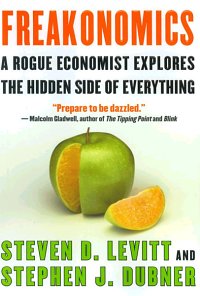
Freakonomics


I have been wanting to write this review for a long time now. I picked up this book from my favorite Tata Book House in Bangalore. (for an extra 10% discount and told the lady at the counter how much I liked the store and have been buying books from them for the past 10 years in spite of me working for the world’s biggest online book retailer).

Now about the book, I should say a very interesting read. A must read for information junkies, it provides numerous references to facts and correlates many of them. The main theme of the book is about asking interesting questions and trying to answer them with numbers and statistics. It is mostly analyzing tons to collected data and arriving at conclusions. And I should say in most his examples he makes a very interesting case for the way he munches these numbers to bring out the bottom line.

Here is one of the interesting questions:
Why do drug dealers still live with their moms ?
In most cases he talks how answers derived by conventional wisdom are not entirely correct and how numbers can be used to better answer such questions.
A fun read over all, easy writing style and is kind of gripping when you see it unfold and the way it defies common sense in many occasions.

Well if you are too lazy to read, then watch this author talk, the talk is very funny and nice, it is only 20 mins.