Sunday, January 4, 2009

The God Delusion - Richard Dawkins


When one person suffers from a delusion, it is called insanity. When many people suffer from a delusion, it is called Religion. - Robert Pirsig, Author of Zen and the Art of Motorcycle maintenance.

The God Delusion, a 400 page best-seller by one of the world's most passionate atheists and renowned biologist is an eye-opener into the realm of religion, creationism and intelligent design. Richard Dawkins, a Darwinian at soul, asks the hard questions about existence of God and religion, that most of us dare not ask with fear. Though the book may not convert a theist into an atheist, it definitely influences you in becoming a deist or makes you ponder about the other options (other than being creationist) or at least makes you think twice the next time you follow something that is indoctrinated on you.

The book starts off by clarifying the misconstrued word "God", when used by Einstein and other scientists ("God does not play dice" -Einstein). The book gets riveting as Dawkins proposes different arguments justifying the existence of God. Some of the arguments are truly intriguing and the author refutes all of them pretty systematically. The best arguments are,

The Ultimate 747 Gambit - "probability of life originating on Earth is no greater than the chance that a hurricane, sweeping through a scrapyard, would have the luck to assemble a Boeing 747"

The Pascal Wager - "even though the existence of God cannot be determined through reason, a person should "wager" as though God exists, because so living has potentially everything to gain, and in theory nothing to lose"

Irreducible complexity - "A single system which is composed of several interacting parts that contribute to the basic function, and where the removal of any one of the parts causes the system to effectively cease functioning."

Dawkins brings forth the infinite regress of "who is the creator of the creator?" as a counter-argument. He also feels that the proposer of a particular dogma should prove it logically rather than claiming it as proved just because it cannot be disproved. Bertrand Russell's teapot logic is used to humorously present this idea. The author then moves on to show that morals don't stem from the scriptures, for people who believe that for a human being to act morally fear of God/religion is very important. Dawkins criticizes the scriptures, drawing examples from both the new testament and the old testament as well as religions like Islam to show that the scriptures are devoid of morals. He talks about the moral zeitgeist by citing examples of changing moral standards over time to prove this point. He ends the book by talking about religion for consolation and inspiration and discussing their importance. Dawkins feels that the world of science, with it's infinite unknowns and truth seeking is inspiration enough to lead a motivated life making religion unnecessary.

A good read that opens up our minds into the limitations of our mind, the possibilities of science and the pitfalls of religion. Dawkins is very meticulous in his research and his presentation is commendable. He doesn't cover oriental religions in depth and feels that Buddhism is more of philosophy rather than a religion, with which I concur. I loved the theme that Dawkins reiterates, "There is no Catholic child or a Muslim child, rather there is a child born to Catholic parents or Muslim parents". Religion should be a prerogative of the child. The ten commandments of humanism is pretty impressive and is quoted in the book. I am yet to read and gather from the critics of this book, which will be my exercise over the next few month.


Here is an excerpt from the preface that is very compelling,

“Imagine, along with John Lennon, a world with no religion. Imagine no suicide bombers, no 9/11, no 7/7, no Crusades, no witch-hunts, no Gunpowder Plot, no Indian partition, no Israeli/Palestinian wars, no Serb/Croat/Muslim massacres, no persecution of Jews as 'Christ-killers,' no Northern Ireland 'troubles,' no 'honour killings,' no shiny-suited bouffant-haired televangelists fleecing gullible people of their money ('God wants you to give till it hurts.')”

Friday, December 26, 2008

Tuesdays with Morrie - An old man, a young man and Life's greatest lessons


I chanced upon this book at a book fair and on recommendation from my better half's friend, thought I should give it a read. A light read, Tuesdays with Morrie covers the last class, a series of conversations, between a professor, Morrie Schwartz, and his favorite pupil, the author of this book, Mitch Albom. Morrie Schwartz, a professor at Brandeis is diagnosed with ALS or Lou Gehrig's disease, a debilitating disease causing muscle atrophy that comes with a death sentence, a few months after contraction. His favorite student, Mitch Albom has graduated from college, forgotten about his past, fully immersed in the pressures of daily life and is in hot pursuit of career laurels for a full 16 years before he sees his dying teacher on television and tries to get in touch with him again.


Morrie is glad to see Mitch back and they decide to meet every tuesday (as they did in college)and Morrie delivers his thoughts about things that Mitch has made a note off. They cover family, career, death and other aspects of life. As Morrie goes through pains of approaching death, he feels he can shed light to people who have seen life, but not death.


While reading the book, I felt a little bit guilty of my own self-centered busy life, devoting very little cycles to keep in touch with people who have shaped my life. Many of Morrie's thoughts are not new, but once in a while someone needs to highlight them and remind us, this is exactly what the book does. Some of Morrie's thoughts are also borrowed from Zen-buddhism. Though the 180-page book doesn't give any new insights or change your perspective dramatically, it does refresh your values and brings focus into things that actually make our lives worth living. I remembered one of my instructors always telling me to "invest in people", a theme that comes out in the book too.


Here are few quotes from the book,

"Love each other or perish." - The central theme of the book.

"Once you know how to die, you know how to live."

"You're not a wave, you're part of the ocean."

"If you can accept that you can die at any time - then you might not be as ambitious as you are."

"People are only mean when they're threatened."

"Death takes away life, not relationships."
"You live on - in the hearts of everyone you have touched and nurtured while you were here."

Wednesday, November 19, 2008

The Ice Limit

Douglas Preston and Lincoln Child sure do know how to keep you up all night. You have an important meeting early in the morning but you just can't keep their book down.

The Ice Limit falls under the category of sci-fi that won't require you to keep your brains in the shoe stand while reading it.

Here is the gist:
A team composing of  a few brilliant scientists, engineers and workers lead by a whimsical multi billionare head on a journey to Chile to retrieve what they think is the biggest meteorite on Earth. The density is measured wrong along with other chemical composition tests that result in the meteorite, that's just about 20-30 feet wide (I can't remember this exactly), ending up being over 40,000 tons heavy putting it's density off the charts.
Anyhow they manage to load it up on a ship (and I can go all day about the brilliant equations and explainations involved but I'll leave it for you folks to cherish it).
Due to unforeseen circumstances the ship drowns causing the meteorite to sink to the bottom. Since it happend in 'The Ice Limit' - right where the cold waters begin, most of the survivors are frost bitten.

The few that recover hear news reports of earth quakes and tsunamis occuring and all of them point to where the meteorite sank.

Read the novel to find what the meteorite actually is. Read this novel for excellent (scratch that, outstanding is the word) character portryal. Read it for knee jerking action.

Update - There is a sequel for this novel coming up with a team being put together to reterive/ destroy the meteorite and my oh my, myself and Preetha are excited :)

Wednesday, September 17, 2008

India After Gandhi: The History of the World's Largest Democracy


History for Indian children, Ramachandra Guha aptly remarks in India After Gandhi: The History of the World's Largest Democracy, runs right out of content in 1947.
All that has happened during the last 55 years may filter through the measly civics syllabus, popular cinema and television; history as formally constituted knowledge of the past does not cover it.
But even this overestimates how much recent history Indian children manage to encounter. Images of the past through civics, popular cinema and television? Bah. My civics textbooks were BORING and they had NO context: every aspect of Indian democracy seemed to have emerged in a vacuum. Hindi films may be a treasure trove for sociologists interested in examining the structures of Indian society but someone hoping to glean a narrative of India's 55 democratic years will have to have superhuman cognitive powers if they rely only on our movies alone.

History after 1947 plays no part in our high school history curriculum. And the history syllabus for schools is crucial since it is probably the only time where history is studied systematically. For glimpses of the more recent past, Indian children have only their newspapers to rely on since newspapers will always include a cursory paragraph or two about the related past, even has they report on current events. The paragraph is usually very cursory. ("The Kashmir dispute started in 1947" or "The roots of the current issue go back to the 1975 Emergency"). But enough to at least know what happened and when (well, roughly). But read enough news articles and one could conceivably learn an impoverished sketch of India's recent past.

Why do history textbooks give not even a cursory narrative after 1947? Guha offers one interesting reason:
If, for Indian children, history comes to an end with independence and partition, this is because Indian adults have mandated it that way.
There is definitely some truth here. I once asked my father why we only had the first 4 volumes (covering the events until 1940) of Y. D. Phadke's Veesavya Shatakatil Maharashtra (Maharashtra in the 20th century: Phadke planned to write 8 volumes, each covering a decade until 1980, and finished 6 before he died this year.) My Dad replied that he didn't really need books for the decades after 1940 since he'd actually lived through it!

The gerontocracy of our history-writers (and readers!) is hardly the reason why no narratives of the last 50 years makes it into our history textbooks though. A bigger reason is that there is no consensus on how we view what has happened in the last sixty years -- things are too "controversial" to be discussed with children. Why and how this is so is hardly the topic for a blog-post -- although one can get an understanding of it after reading Guha's book.

So has nothing been written on India about the past 55 years? Well, there is, but it's not history. Here's Guha again:
In the academy, the discipline of history deals with the past, while the disciplines of political science and sociology deal with the present. This is a conventional and in many ways logical division. The difficulty is that in the Indian academy the past is defined as a single, immovable date: 15 August 1947. Thus when the clock struck midnight and India became independent, history ended, and political science and sociology began.
To remedy this, Guha has dug through the "present": through newspaper and magazine archives, through academic and popular books on sociology and anthropology (and of course, his own experience) and crafted a narrative that takes us through India's post-independence years -- all in a cool 800 pages. As as summary of the recent past, I think it's pretty good.

I have a couple of minor quibbles with the book. I wish Guha hadn't crammed 50 years of about films and music into one last chapter called "The People's Entertainments", rather than interweaving it with the tale that occupies the rest of the book. And I would have liked a more detailed narrative of India's economic policies. But in his primary task, that of writing a history of Indian democracy, he does very well.

And along the way, he sprung some surprises on me as well. I had always thought that the Allahabad Court Ruling against Mrs. Gandhi that led to the actual imposition of the Emergency in 1975 was about some substantial electoral malpractices. Instead did you know that 12 out of the 14 charges against her were dismissed? And that out of the two counts on which she was convicted, one had to do with her constructing a dias that allowed her to address people from a dominating position when she gaves speeches, and the other was that her campaign manager was still in government employment when the campaign began! Trivial? I mean Indian politicians do this all the time! The mind boggles. Now I am probably underestimating the symbolic importance of the ruling -- plus the fact that those were turbulent times. All good points. But when one gets one's history from one-paragraph summaries in newspaper articles, (smaller) points like these are invariably left out. (Notice the Wikipedia paragraph I linked to before mentions nothing about the charges on which Mrs. Gandhi was actually convicted).

Reading Guha's book led to a lot of such small moments of revelation (most of which I don't even remember now). And -- which brings me to the real point of this post :-) -- Guha's book comes with an extensive set of footnotes., many of them pointing to notable books about post-independence India. What follows is a list of books (and perhaps an essay or two), about India's "present", topic-wise, culled from the notes, based on my own, somewhat idiosyncratic interests. Most of Guha's bibliography tilts towards books written in English or available translations of books in other languages. Still - something is better than nothing. To avoid making this post bigger than it already it, I have posted it in the comments. Enjoy.
----------------------------------------------------------------------------------
UPDATE: Ha. The formatting gets messed up in the comments so I am posting it here itself.

Nuclear Tests:
Ashok Kapur, Pokhran and Beyond: India's Nuclear Behavior (Oxford).
Hillary Synnott, The Causes and Consequences of South Asia's Nuclear Tests
M. V. Ramanna and C. Ramamanohar Reddy, Prisoners of the Nuclear Dream

Kargil:
Hassan Abbas, Pakistan's Drift into Extremism
Aijaz Ahmad, The Many Roads to Kargil, Frontline, July 1999.
Praveen Swami, The Kargil War.
Rahul Bedi, Dismal Failure: Essays on the Kargil War.
Sanjoy Chowdhury, Dispatches from Kargil.
Guns and Roses: Essays on the Kargil War.

Economic Liberalization:
Rahul Mukherji, India's Aborted Liberalization: 1966, Pacific Affairs 73(3), Published in 2000.
Gurcharan Das, India Unbound (an fairly popular idiosyncratic account of the 1991 liberalization).
A Kochanek, Regulation and Liberalization in India, Asian Survey, Vol 26, No 12, 1986
Supriya Roychowdhury, State and Business in India: The Political Economy of Liberalization 1984-89, Unpublished Thesis, Dept. of Politics, Princeton University

Corruption in contemporary India:
Shiv Visvanathan and Harish Sethi (Eds), Foul Play: Chronicles of Corruption

Narmada Valley and Big Dams:
Amita Baskar, In the Belly of the River: Adivasi Battles over Development in the Narmada Valley
Jean Dreze, Meera Samson, Satyajit Singh (Eds) The Dam and the Nation

Kashmir:
Manoj Joshi, The Lost Rebellion
Tavleen Singh, Kashmir: A Tragedy of Errors
M. J. Akbar, India: The Seige Within
Michael Brecher, The Struggle for Kashmir
Sisir Gupta, Kashmir: A Study in India-Pakistan Relations

Punjab/Khalistan:
Anup Chand Kapur, The Punjab Crisis
Ram Narayan Kumar, The Sikh Unrest and the Indian State.
Mark Tully and Satish Jacob, Amritsar: Mrs. Gandhi's Last Battle
Satinder Singh, Khalistan: An Academic Analysis
Hamish Telford, The Political Economy of Punjab: Creating Space for Sikh Militancy, Asian Survey Vol 32 No 11 November1992

Delhi Anti-Sikh Riots:
Uma Chakravarti, Nandita Haskar, The Delhi Riots: Three Days in the Life of a Nation
Anon, Who are the guilty: Report of a joint enquiry into the cuase and impact of the riots in Delhi from 31st October to 10th November (PUDR and PUCL, 1984)

Hindutva:
D. R. Goyal, The Rashtriya Swayamsevak Sangh

Communal Riots:
Dilip Padgaonkar (Ed) , When Bombay burned
Siddharth Varadarajan (Ed), Gujarat: The Making of a Tragedy
Ashgar Ali Engineer, Communal Riots in post-independence India
M. J. Akbar, Riot After Riot.

Ayodhya:
Nilanjan Mukhopadhayay, The Demolition: India at the crossroads.
Christopher Jaffrelot, "The Hindu Nationalist Movement and Indian Politics: 1925 to the 1990s"

The Kaveri dispute:
Ramaswamy R. Iyer, Water: Perspectives, Issues, Concerns.
S. Guhan, The CAuvery River Water Dispute: Towards Conciliation

Bofors:
Chitra Subramaniam, Bofors: The story behind the news

Panchayati Raj/Decentralization:
Mahi Pal, Panchayati Raj and Rural Governance: Experiences of a Decade, Economic and Political Weekly 10th Jan 2004

Muslim Life:
M. K. A. Siddiqui (Ed), Muslims in Free India: Their social life and problems.
W. C. Smith, Modern Islam in India
W. C. Smith, Islam in Modern History. (both famous books but they only go up to the 1940s).

Recent Dalit politics/caste/Dr Ambedkar/Dalit literature:
Jayashree Gokhale, From concessions to confrontation: The politics of an Indian untouchable community.
Eleanor Zelliot, Untouchable to Dalit: Essays on the Ambedkar movement
Valenan Rodrigues (Ed), B. R. Ambedkar: Essential Writings
Arjun Dangle (Ed), Poisoned Bread: Translations from Modern Marathi Dalit Literature
Narendra Jadhav, Outcaste: a memoir (translated from Marathi)
Vasant Moon, Growing up Untouchable in India, translated from Marathi by Gail Omvedt
Vasant Moon, Dr. Babasaheb Ambedkar, translated from Marathi by Asha Damle
M. N. Srinivas, Caste in Modern India, Jan 1957, Address delivered to the Science Congress in Calcutta
Chistopher Jaffrelot, India's Silent Revolution: The Rise of the low castes in North Indian Politics.
Sudha Pai, Dalit Assertion and teh Unfinished Democratic Revolution: The Bahujan Samaj Party in Uttar Pradesh.
Kanchan Chandra, Why Ethnic Parties Succeed: Patronage and Ethnic head counts in India.

1975 Emergency:
Rao and Rao (Eds) The Press she could not whip

Rural Life and Democracy:
Ashutosh Varshney, Democracy Development and the Countryside: Urban Rural Struggles in India

Environment:
Ramachandra Guha, How much should a person consume? Environmentalism in India and the U.S.

Bombay 1980s (the mill worker's strike):
Rajni Bakshi, The Long Haul: The Bombay Textile Worker's Strike.
Meena Menon and Neera Adarkar, One Hundred Years, One Hundred Voices, The Millworkers of Goregaon: an Oral History

Early conflicts of the Indian Republic (primarily the reorganization of states along linguistic lines):
Robert Stein, "The Process of Opposition in India"

The China conflict:
Steven A. Hoffmann, "India and the China crisis"
J. P. Dalvi, Himalayan Blunder
Neville Maxwell, India's China War (seen from the Chinese perspective).

On the making of India's constitution:
Granville Austin, The Indian Constitution: The Cornerstone of a Nation

Indian Cinema:
History:
Erik Barnouw and K. Krishnaswamy, Indian Film (2nd Edition)
B. D. Garga, So Many Cinemas: The Motion Picture in India
Ashish Rajadhyaksha and Paul Willeman (Eds), Encyclopaedia of Indian Cinema
Narrative Structure:
Nasreen Munni Kabir, Bollywood: The Indian Cinema Story
Panna Shah, The Indian Film
Agehananda Bharti, Anthropology of Indian Films, Illustrated Weekly 30th Jan, 6th Feb 1977
Songs/Music:
N. M. Kabir, Playback Time: A brief history of Bollywood film songs, Film Comment May-June 2002.
Manek Premchand, Yesterday's Melodies, Today's Memories
Bonnie C. Wade, Music in India: The Classical Traditions

Television in India:
Arvind Rajgopal, Politics After Television: Religious Nationalism and the Reshaping of the Indian Public
Sevati Ninan, Through the Magic Window: Television and Change in India

Sri Lankan Conflict:
A. Jeyaratnam Wilson, Sri Lankan Tamil Nationalism: It's origins and Developments in the Nineteenth and Twentieth Centuries
Sankaran Krishna, Postcolonial Insecurities: India, Sri Lanka and the Question of Nationhood.

Friday, September 5, 2008

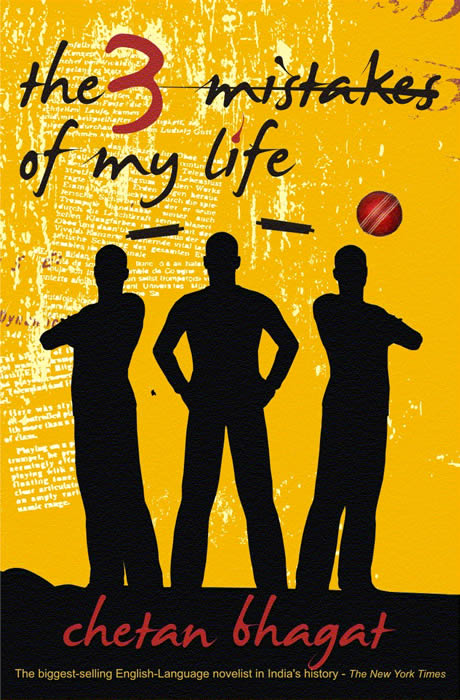
The 3 Mistakes of my life - Chetan Bhagat

India has seen quite a few English writers in the past, from R. K. Narayan known for his simple, yet lively writing to Shashi Tharoor whose breadth and variety has captured people's imagination. Though I wouldn't place Chetan Bhagat in the same league, he has managed to capture a pretty big audience, the youth of India, between 15 and 30 years of age, by targeting his writing to their needs and basing his works on their lifestyle. After a hugely popular "Five Point Someone" and a popular "One Night at the call center", Chetan Bhagat presents his 3rd book, "The 3 mistakes of my life". Having read "One night at the call center", I wasn't very impressed with his writing style nor his "God speak" theme in the book. But I must give credit to his simple writing style, use of appropriate lingo and realistic description of details. I chanced upon this book, it has been a while since I read a book, so I thought this 250-pager story could be breezed through and would also provide me the required warm-up to bootstrap my reading habit again.

This book is a story that delves deep into the life, emotions and aspirations of a young Gujarati businessman. The story is set in the early part of this millenium and covers many news events like the earthquake at Bhuj, the Godhra train incident, India's spectacular series triumph against Australia and the Gujarat communal violence. Chethan Bhagat narrates the Gujarati lifestyle in good detail with emphasis on the psyche of the Gujarati youth. The story is pretty gripping in the second half of the book. Though Brett Lee becomes Fred Li and Modiji is Parekhji, the essence comes through pretty well in the book. On the flip side, the book reminds me of a typical bollywood movie, love story to fight scenes and all the melodrama in between. I wouldn't put this book in the must read category, but do read it if you want a peek into the society one of the most enigmatic states in India, a state flanked with phenomenal progress on one side and communal bias on the other.
Overall, a light read that can be raced through, if you have nothing else to do.

Tuesday, May 27, 2008

The Elephant, the Tiger, & the Cell Phone


For those who are new to Shashi Tharoor's non-fiction work this might be a good start. It is a collection of essays covering a wide range of subjects from politics, ailing sports except for cricket, the rising economy and pluralistic Indian society. It is a good collection of facts, analysis, sprinkled with sometimes subtle but otherwise straight humor. Dr. Tharoor talks about Indianness in the emerging world of globalization. He touches on oddities such as India being at the forefront in adopting technologies like cell phone but still believing strongly in theories of numerology/astrology may be even while choosing a cell number. This is a serious piece of work one might want to read to get in touch with issues, conflicts, advantages and sometimes plain facts about India in the past 10 years.

Here is Shashi Tharoor on his book..


Sunday, March 9, 2008

Neither Here nor There: Travels in Europe -- Bill Bryson

Close friends know I have been bitten by the travel bug ever since I read Eat, Pray, Love. I have been doing the "I need to go to Italy" chant for the past few months. Bill Bryson's 'Neither here nor there' managed to add just about 30 other places to the chant.

The book is Bill's humorous (not always the laugh-out-loud kind of humor, but the amused-grin-evoking kind) recounts of his travel around various cities in Europe.

The thing I liked most about his potrayals of these various places was how he pays so much attention to the people and the culture itself as opposed to the palaces and the museums and the gardens. Personally to me, that is what is most intriguing about a new place.

The narration has the lighthearted tone of a relaxed back-packer taking his time to soak up the essence of a new place. Facts have clearly been exagerrated here and there to achieve a part-comical, part-acerbic flavor - but that is a humorist's license, is it not?

Excerpts:-
--------------------------------------------------------------------------------
The Romans park their cars the way I would if I had just spilled a beaker of hydrochloric acid on my lap.
--------------------------------------------------------------------------------
The problem is that [in Paris] the pedestrian crossing lights have been designed with the clear purpose of leaving the foreign visitor confused, humiliated, and, if all goes according to plan, dead.
--------------------------------------------------------------------------------


Now, for the nit-picking: on the whole, the book gave me the impression that there were more places that displeased him than delighted. A little more cribbing than I would generally choose to hear :).

Otherwise, an apt book for a travel enthusiast in a very ironical way - it leaves you with the feeling that you've had enough reading about it and you just need to take the next flight.

Thanks to Sandeep for lending me the book! :)