Friday, October 15, 2010

Genghis Khan and the Making of the Modern World

I just started reading this interesting memoir of Genghis Khan. I am only about 20 pages into it, but for some reason it has started sparking insights about the ways in which a history-changing khan thinks differently from someone like me. I had to write it down and hence this post comes much before I actually complete reading the book :).

This post wont be a book review at all, but rather a ramble about my aha-moments as I read through the first few pages.

Let me start by giving specific examples and use that to drive home my generalized "aha!"s.

One of Genghis Khan's strategy to scare tribes and kingdoms into surrender was to brutally kill his captives in public - burning them alive, using them as cannon balls, just to list a couple. Now that is superlative of cruelty by any standards. But at the same time, he was highly supportive of teachers and doctors and craftsmen, to the extent that he did not even tax them! I wasn't able to wrap my head around the kind of person that he was - did he suffer from MPD? How else can one be both barbaric and thoughtful towards fellow beings? Just as I was about to dismiss him as a confused personality, I realized that his thoughts, principles and priorities were at a totally different plane than mine. With goals as lofty as wanting to unite the world for the greater good of mankind and to reduce tribal feuds, one cannot afford to focus on lesser principles that do not hold any value towards the bigger vision. If brutal murder of a few human lives is what it takes to reduce further bloodshed and is what takes him closer to his all-human-race encompassing dream, then so be it!

Genghis Khan also played on the religious beliefs of common man in his elaborate ploy to earn their loyalities and turn them against those he did not like. This obviously indicates that he himself did not believe in those religious beliefs. What do we do when we do not believe in the religious practices of our families or our clan? We crib about it, refuse to follow them, argue with the folks who hold these beliefs and talk about how we would abolish these baseless beliefs if we got a chance to rule the world. What does this leader do? - he quietly realizes that these religious beliefs or practices were created for a social reason; and uses them to his advantage without creating a hullaballoo about it. If that means he has to act like he holds the same beliefs as the people he is trying to manipulate, then so be it! Participating in a few rituals and following a few pratices that hold no meaning for him is a small price to pay for the large win that it gets him.

My ahas:-
- When we plan towards a goal, we plan for small wins along the way. When the Khan strategizes, his plans involve subjecting himself to small losses or discomfort along the way.
- Family and friends and life's experiences teach us certain principles and we follow these principles in our everyday life as we work towards our goals. The khan's goals defined his principles!

The difference between good and great seems so small, but yet so large.

Sunday, May 9, 2010

What Do You Care What Other People Think? - Richard Feynman


Yet another book that documents the life of one, if not the only colorful scientist of recent years, What Do You Care What Other People Think? is a 200+ page refreshing read. The book has 2 parts to it, the first covering anecdotes and letters from Feynman's life, including a touching story of his first wife Arlene, who succumbed to tuberculosis quite early in Feynman's life. The second half covers Feynman's involvement in the Rogers Commission, that was formed in 1986 to investigate the Challenger space shuttle incident. The penultimate chapter of the book includes Feynman's report in the Rogers Commission - a frank and candid assessment of the shuttle program and NASA that went out as an appendix in the main report that was submitted to the White House.

The first half of the book makes the reader feel that this is a continuation of the book "Surely Your're Joking". I would agree it is (I have read only half of the SYJ book), but personally I felt the best part of the book was the second half - Feynman's involvement in the Shuttle accident probe. Feynman covers a variety of topics in the first half like his impression of Post-war Poland and his paranoia of being bugged at his Warsaw hotel, his Dad's influence in learning the "scientific" way (knowing the principles rather than the name), his struggles as Arlene - his first wife goes through tuberculosis and her death, his experiences in Japan and so on. It also includes letters written to his family and also letters written by others about him.

In the second part of the book, Feynman gives a detailed description of the Rogers Commission, where he was one of the Commissioners along with people like Neil Armstrong and Sally Ride. His meticulous investigation methods are impressive as he explains the parts of the shuttle and the problems with the rubber O-rings in the booster rocket field joints that were most probably responsible for the disaster. Feynman, an exponent of the scientific method carries out experiments with pieces of rubber removed from the booster rocket field joints to demonstrate his point on how lower temperatures during launch might have caused fuel leakage on the shuttle.

When involved in the probe, Feynman discovers many irregularities, communication roadblocks and poor administration in NASA. His report observes the following 1) Though the failure probabilities of the O-rings was known to be 1 in a 100 (0.01) (estimated by the O-ring vendor and by the ground engineers at NASA), NASA allowed usage of the O-rings, with the management insisting that the failure probability was 1 in a 100000. NASA was taking it's chances as nothing other than minor incidents had occurred with the use of the O-rings thus far. 2) The shuttle engines are built top down making it very expensive to change and increasing the maintenance overheads of the engines. Feynman argues that for critical parts like the engine, a bottom up approach needs to be taken and robustness of all the components must be ensured before assembly. An aircraft engine is designed bottoms up. 3) Feynman is pretty impressed with the Avionics group of NASA, who build the software for their missions. He commends their methods, the rigorous tests the software is put through at various stages and the redundancy that is built into the shuttle. However, he is not happy with the shuttle's obsolete hardware and the downsizing of testing infrastructure and resources for the software units by NASA. In all of the above points, NASA was trying to save costs by reducing investments in the same safety nets that had made their mission successful so far. For example, the avionics onboard the shuttle was immaculate because of the rigorous tests involved and NASA wanted to downsize the tests themselves.

The book concludes with one of Feynman's lectures on the "Value of Science". The essence is similar to the lectures in the book "The meaning of it all" like the importance of doubt and how social problems are harder than scientific ones.

Overall a weekend read that gives you a peek into the working of America's premier space agency of the 80s.
"To every man is given the key to the gates of heaven; the same key opens the gates of hell."

Thursday, April 8, 2010

Open: An autobiography by Andre Agassi


Did you know

(a) That Andre Agassi's long-haired famous mullet was actually a wig?

(b) That the reason he lost the 1990 French Open Final to 30-year old veteran Andres Gomez was because his wig threatened to fall off?

(c) That Agassi has a wonderful way of appearing to compliment people when he's really insulting them? (C.f. Brooke Shields, Pete Sampras).

(d) That he's really really sore about losing so many times to Pete Sampras but can channel his resentment wonderfully by focusing, for example, on Sampras' boringness or his inability to tip well?

(e) That he and Brad Gilbert called Boris Becker "B. B. Socrates" because they thought that he (Becker) tries to come off as an intellectual when he's just an "overgrown farm boy". That Agassi's hatred of Becker sustained him to play well for at least a year?

If you didn't know any of these, and if you like tennis and/or Andre Agassi himself, then by all means, read Open, Agassi's pretty well-written autobiography. I had a great time, for sure.

The first clever thing that Agassi did was in getting J. R. Moehringer to write it for him. The combination of Agassi's personality and acute observations along with Moehringer's writing makes the book worth reading.

Agassi also doesn't make the mistake of trying to distill his life to any easy lessons. Of course, there's a lot about what a tyrant his father was, and how Andre struggled to find himself, but not something like "If you want to lose weight, you must do X, Y and Z."

He also doesn't just give a censored version of his life but puts some of the juicier bits in as well. Drugs, bits of his love life, his tangled relationship with his family, his hair loss, everything's in there. (Not everything, of course. But what's in there is fairly interesting.)

He also gives some wonderful descriptions. Here is one, that occurs at the beginning of the book, of his own exhaustion, and of playing through pain and how the service box appears to shrink in size:
Easier said than done. The box is shrinking. I watch it gradually diminish in size. Can everyone else see what I'm seeing? The box is now the size of a playing card, so small that I'm not sure this ball would fit if I walked it over there and set it down. I toss the ball, hit an alligator-armed server. Out. Of course. Double fault. Deuce number eight.
There's a wonderfully funny passage where he imagines people's reactions had his wig fallen off during his French Open Final:
With every lunge, every leap, I picture it landing on the clay, like a hawk my father shot from the sky. I can hear a gasp going up from the crowd. I can picture millions of people suddenly leaning closer to their TVs, turning to each other and in dozens of languages and dialects saying some version of: Did Andre Agassi's hair just fall off?
His remarks about Jim Courier, Michael Chang and Pete Sampras winning a grand slam before him:
Bad enough that Chang had won a slam before me. And Pete. But Courier too? I can't let that happen.
There's a wonderful description of how he tanks a match (which I don't quite buy):
But losing on purpose isn't easy. It's almost harder than winning. You have to lose in such a away that the crowd can't tell, and in a way that you can't tell -- because of course you're not wholly conscious of losing on purpose. You're not even half conscious. Your mind is tanking, but your body is fighting on. Muscle memory. It's not even all of your mind that purposely loses, but a breakaway faction, a splinter group. The deliberately bad decisions are made in a dark place, far below the surface. You don't do those tiny things you need to do. You don't run the extra few feet, you don't lunge. You're slow to come out of stops. You hesitate to bend or dig. You get handsy, not using your legs or hips. You make a careless error, compensate for the error with a spectacular shot, then make two more errors, and slowly but surely you slide backward. You never actually think I'm going to net this ball. It's more complicated, more insidious.
I could go on and on. But I'll stop right here.

I'll make one point before I end though. In Freud's terms, everyone consists of an id and an ego. The id is your unconscious, responsible for all the dark desires, the weird likes, the irrational hates. The ego is your "rational" half, regulating everything, making you appear civilized. The problem with superstar autobiographies is that they tamp down on the id, neutering it, which results in a boring book. Open uses Agassi's phenomenal id in just the right amounts -- the result is a fun read.

Tuesday, March 23, 2010

Kalki - Gore Vidal

Narrator: Teddy Ottinger, a bisexual aviatrix

Plot: An American guy based in Katmandu proclaims himself to be Kalki, the final avatar of Lord Vishnu. He claims and announces that he will end the human race on April 3rd that year. He recruits Teddy Ottinger for his mission. How does he plan to do it? Will he succeed?

Verdict: A definite page turner with an unexpected ending. Well, actually 2 unexpected endings ;-)

What the Dog Saw - Malcolm Gladwell

A compilation of random articles that Gladwell wrote for the NY Times. They are all available online too, but somehow I have a preference for reading them on paper. Well, I am old-fashioned that way :).

As you can expect from Gladwell - lots of lots of interesting stats, lots of anecdotes and good story telling. But he does not go beyond the "safe" boundary and make bold statements or conclusions. Nevertheless, it is definitely a fun read and gives a good deal of new information and new perspectives.

The things that impresses me most about him is that he is interested in and collects information/anecdotes from people from all walks of life - from doctors to construction workers to dog trainers. Reading his articles, you realize how little you are exposed to, to people from fields that are not yours.

Read this for a sample: http://www.gladwell.com/2000/2000_03_10_a_rock.htm

Thursday, January 28, 2010

What I Believe - Bertrand Russell

"A good life is one inspired by love and guided by knowledge" - Bertrand Russell

"What I believe", an essay outlining Russell's thoughts and hopes, written early in the 20th century (1925) is a 40-page successor to his pessimistic world view outlined in "Icarus" . Perhaps one of the boldest and brightest philosopher and writer the past century has seen, most of Russell's thinking has stood the test of time. The reason being pretty simple, his thoughts far-sighted and their basis not ephemeral.

In this essay, Russell starts off with the neutrality of nature, nature being neither good nor bad. This is a direct attack against Liebniz-like optimism and extreme pessimism. He then moves on to define a "good life" (quote at the beginning of this post) and talks in length the importance of both love and knowledge, it's key components. Russell points out the dangers of having one but not the other component with examples. Russell moves onto discussions around morals, quoting that morals and ethics are derived from conflicting desires, a code or rule book that prevents or avoids such conflicts. In the entire essay, Russell is particularly harsh on the church, on religion and even nationalism.

The author also delves into the concept of salvation, the fallacies of education and the tradeoffs involving scientific advancement. Russell is not convinced with the education system in his times (I am not sure if it has changed much) and feels that children lose their faculty in curiosity as they spend their precious years in schools.

Overall, a quick read, many issues that author has brought into light are very much pertinent even to this day. Russell is pretty caustic in some places, but that's when he is at his best.

Sunday, December 13, 2009

Is God a Mathematician? - Mario Livio


Is God a Mathematician? Is Mathematics the language of the universe? Is it an invention or a discovery? Mario Livio tries to present arguments for and against these questions with chapters from mathematical history, concepts from the umpteen branches of mathematics, anecdotes from the lives of great Mathematicians and verbatim quotes from their journals in a 252-pager thriller. The story-telling in the book is fantastic and I found the latter half of the book particularly gripping. A note of trivia about the author - Mario Livio is the same author who wrote about the "golden ratio", a book and the ratio that got a mention in Dan Brown's Da Vinci Code.

The first half of the book presents the mathematical views of the ancient world like the Pythagorean mathematicians and the works of Euclid and Plato. He talks about the Tetraktys and Gnomons, tools developed by the Pythagorean mathematicians that proved certain theorems by inspection. Mario Livio then dwells into the 4 people whom he considers as the giants in Mathematical progress, in chronological order, giving historical insights into their lives and work. The author talks about Archimedes, who quoted “Give me a place to stand, and I will move the Earth”, for his genius in designing pulley-based contraptions, his work on displacements of liquids and his work on finding volumes of 3-d objects in an age where integral calculus was not known. He then moves to Galileo and his work on the acceleration of falling bodies, his evangelism of astronomy and the invention of the telescope. Then on the work of Rene Descartes, that led to the unification of algebra and geometry with concepts what we call as "Analytical Geometry", a breakthrough in math that made the very foundations of geometry stronger and provable. The fourth great one is of course Newton, for his work on gravity that changed not only the perspective of how we view the falling apple but also it changed the way we looks at the solar system and the universe. As a by product, Newton independently gave us calculus along with Leibniz. Mario Livio goes to exhibit the platonic view these mathematical giants had almost convincing the reader that Math had to be a discovery rather than an invention. But hold on, now there is a twist to this tale.

Till this time in history, Euclidean geometry was considered the ultimate truth and the perceived universe seemed to be behaving consistently with these postulates. Euclid's 5th postulate, the parallel postulate, was taken for granted till geometries of curved surfaces came into existence. Curved surfaces posed a new difficulty, it put Euclidean geometry in a fix as it did not behave consistently with the Euclidean postulates. These new-Euclidean surfaces and geometries gave way in the belief that after all Math is an invention, a figment of human thought. Mario Livio goes into the lesser known mathematicians of the non-Euclidean geometries and mentions names like Gauss and Riemann and skims through their work, the latter's geometry forming the building block for Einstein's theories in the future.

The author moves onto Logic and Mathematics, their relationship, discussing the works of George Boole (Boolean algebra), Bertrand Russell (Russell's paradox) and Kurt Godel (Incompleteness theorem) among others. He briefly writes about Godel's "Incompleteness theorem", another shock that rocked the Platonists. Godel showed that any formal system that is powerful enough to be of any interest is inherently either incomplete or inconsistent.

The last few chapters talk about some examples that show the difference between "active" and "passive" applications of Mathematics. Mario Livio covers Knot theory, a mathematical theory that was studied ages before it's application was found, in decoding DNA knots and strands (passive application). He gives a brief description of string theory too in this context. The theories of relativity - special and general are also discussed and their applications in adjusting clocks onboard satellites is given. The author then discusses the opinion of cognitive scientists on the same, which is mostly that Mathematics is an invention of the human intellect. Mario Livio concludes with the answer "it depends", there is math that occurs in nature whose characteristics we have conceptualized in our minds and there is math that purely occurs as thought.

Overall, an interesting read that showcases mathematics - invented or discovered. The book concludes with a paragraph from Bertrand Russell's essay The Problems of Philosophy -
Philosophy is to be studied, not for the sake of any definite answers to its questions since no definite answers can, as a rule, be known to be true, but rather for the sake of the questions themselves; because these questions enlarge our conception of what is possible, enrich our intellectual imagination and diminish the dogmatic assurance which closes the mind against speculation; but above all because, through the greatness of the universe which philosophy contemplates, the mind also is rendered great, and becomes capable of that union with the universe which constitutes its highest good.

Wednesday, November 25, 2009

The Meaning of it all - Richard Feynman


The demand for certainty is one which is natural to man, but is nevertheless an intellectual vice. - Bertrand Russell

A compilation of a series of 3 lectures delivered by Richard Feynman at the University of Washington, Seattle, in 1963, this book delivers profound ideas with a very simple style that can be understood and imbibed by anyone, scientist or not alike. The three lectures are titled, "The Uncertainty of Science", "The Uncertainty of Values" and "This Unscientific Age". The first two lectures have a very good build up and are in continuum, talking about the importance of being uncertain, both in science and in morals or values. The third lecture is a little bit more adhoc as the person delivering the lecture admits and deals with some of the problems we are facing in the current age. Feynman covers both the glaring issues and those that are pretty subtle in nature, potentially harmful nevertheless.

The first lecture is about how uncertainty is important in science inorder to discard older scientific beliefs and embrace newer and more precise ones. Feynman gives the 3 views of the meaning of science, science seen in application of inventions and discoveries (also called technology), science as a body of knowledge arising out of certain inventions and discoveries and the very traditional definition of Science, as a method of inventing and discovering new things. He talks about how scientific statements have to be stated in a precise fashion, leaving very less vagueness and a low tolerance for interpretation, or worse, misinterpretation.

The second lecture is much more interesting as Feynman explores the differences between religious views and scientific views, how uncertainty in values is important, how a "certain" leader is more harmful than an uncertain one, how democracy stems from uncertainty and so on. He makes it a point that "if something cannot be disproved it has to be true" is the most dangerous assumption to be making. This is the same point that the Russell's teapot (see The God Delusion review) analogy explains.

The last lecture is the longest one and deals with a list of problems in this age that makes this age an unscientific one. Here he talks about how quoting probability in experiments after an event has occurred rather than before is not right, how sampling needs to be done for any kind of statistical experiment, how gullible people are by falling for advertising, a skeptic outlook on some of the space missions, questions the need for English teachers and spelling rules, how mind-reading and astrology need to be disowned and so on.

Overall, an engrossing and entertaining 120+ pages, by one of the greatest Physicist and Nobel prize winner in the past century. Though it may not give you the meaning of it all, it does make you a little more uncertain, a little more skeptical and helps you avoid the biggest intellectual vice, Certainty.

Saturday, October 24, 2009

Animal Farm - George Orwell


"All animals are equal, But some animals are more equal than others"

A breezy read, George Orwell's Animal Farm is one of the well known satires on the former Soviet Union's political state under Stalin. This book was written around the time of the 2nd world war and covers the fall of the Tsars and the rise of Stalin. Each powerful leader who influenced the former Soviet Union is represented by an animal, with 2 main characters - Snowball, a pig, alludes to Trotsky and Napolean, another pig, interpreted as Stalin. Napolean is the central character in the whole book.

The story is about a farm, Manor Farm, whose animals rebel (Russian Revolution) against Jones (Nicholas II) the owner of the farm under the leadership of Snowball and Napolean. Old Major's (Lenin or Karl Marx, an old boar in the book) speech is supposed to have spurred the rebellion. The idea behind the rebellion was that all human beings are villains, that led to an opinion, "Four legs good, two legs bad", and was engraved in the minds of all beasts on the farm. The first few chapters are pretty hilarious as the animals take control of the farm, manage it and see a lot of improvements as a consequence. But then, Napolean sidelines Snowball, drives him out of the farm and rises to become a tyrannical leader in the farm. Typical political games like opaqueness in policies, changing government agenda and high handedness by violence are played by Napolean to keep his monopoly as a leader.

There are a couple of wars, once an attack by Jones and company and the other by Mr. Fredrick (neighboring farm owner, alluded to Hitler), both of which are won by the animals, but by incurring a lot of loss and significant fatalities. As the book goes by, you feel bad for the other animals under the autocratic rule of Napolean and his fellow accomplices (other pigs). The story comes to an end with a party where Mr. Pilkington (Americans, another neighboring farm owner) having a party in the farmhouse along with the pigs and the other animals just watch on, quite opposite to the philosophy that led to the inception of Animal Farm.

A nice read, highlighting the consequences of power wielding dictators, communism and the suffering of the proletariat. Though the book talks about the dirty world of politics, the story is well told and brings out the moves of the government each citizen needs to be aware of. Another highlight of the book is that it gives an historical perspective into the state of the former Soviet Union for a good 30 years starting from the Russian Revolution in 1917 till the World War II (1945)

Sunday, July 12, 2009

Candide - Voltaire


A classic along the lines of Gulliver's travels by Jonathan Swift, Voltaire's Candide is a fast-paced chronicle about a simple, naive and pleasant man in pursuit of his beloved, Cunegonde. Like Gulliver's travels, Candide is also a satire, ridiculing ideologies of the 17th century - Leibnizian optimism, the church and religious fanaticism among other contentious issues. When Voltaire came out with this book, it was banned all across Europe and only a few copies remained as they were smuggled out of the continent.

Leibnizian optimism talks about we being in an ideal world where everything happens in the best possible way for the good of the people. Voltaire, an ardent and vocal critique of this view presents the evil in the world, it's suffering and the prevalent tyranny in this story about Candide, who has to travel around the globe in search of his love, a reason for which he was banished from the place he grew up in West Germany. Voltaire is brutal on optimism and the story is pretty depressing as Candide sees omnipresence of evil, that makes him abandon his teacher's (Pangloss) optimistic views, views similar to Leibniz.

Voltaire also attacks the church and it's conservative views. He brings forth the sufferings of slavery and the genocide of natives in Latin America. Islam and Judaism are not spared as Candide travels through Constantinople. Voltaire does cover an utopian El Dorado, perhaps his views of an ideal state, where rationalism rules over wealth and power. Candide also discovers the wave of power, with it's crests and troughs as he meets 6 monarchs in an inn, all bereft of their power and in exile or travelling. After 130-pages of misery, all ends well as Candide is united with his love, his teacher and his confidants.

Voltaire ends the novel with "we must cultivate our garden", after seeing a happy and content farmer and his family at Constantinople. This particular statement is pretty open ended and has attracted many interpretations. Some say it is Voltaire's deistic views, that is God doesn't interfere in our daily activities, it is we who have to cultivate the garden given to us and it is in our hands to make our living the "best of all possible worlds". There are other interpretations like "Work keeps away three great evils: boredom, vice, and need."

Overall, a breezy read with messages well delivered and driven to a point of boredom. But it has a Orwellian hypocritical and depressive air to it.

Thursday, June 4, 2009

ABC Of Relativity - Bertrand Russell


Science is a powerful potion whose consumption converts a dogmatic to a sceptic, and like travel, is fatal to prejudice and pride. But much of science is not popularized and it's depth and concepts are accessible to only unkempt haired, bespectacled, equation-wielding, greek alphabet ace stereotypes whom we brand as scientists. Bertrand Russell, a thinker, philosopher and mathematician, in this book attempts to explain the mysteries of Einstein's theory of Relativity to the common man, a person who has the thirst for this knowledge, but doesn't have the depth or expertise to understand the mathematical intricacies behind it. The 200 pager ABC of Relativity is one of a series of books written by Russell on different topics in science. This 1925 book, written 7 years after Einstein's General theory of relativity, is a credit to Russell's open-mindedness and foresight, personal attributes that are far ahead of his times.

Russell starts off the book by urging the reader to give up thinking in terms of Euclidean geometry and Newtonian physics that we are so used to on earth, a pre-requisite for understanding the theory of relativity. He moves on to explain the misconceptions about the theory of relativity and to describe the properties of light, particularly it's velocity. Russell introduces the Michelson-Morley experiment to measure the velocity of light, whose results called for a new theory, the special theory of relativity. In the middle chapters of the book, the author introduces concepts like the constancy of the velocity of light, time dilation, object length alteration in the direction of motion, Lorentz contraction and space-time, essential concepts behind the Einstein's special theory of relativity.

Russell's explanation of concepts is neither rhetorical nor mathematical, making it very powerful as it can be understood by anyone. His examples are very "earthly", involving objects that we see everyday. After explaining the special theory of relativity, Russell moves to harder concepts like gravitation, formed by space-time hills leading to the general theory of relativity. Personally, I felt concepts around accelaration and gravity a little harder to understand. Perhaps the concepts here are a little more abstract and hard to visualize and imagine. The author also explains the vastness of our expanding universe, sowing seeds of humility in the reader. The book concludes with some philosophical insights.

Overall, a fantastic attempt at popularizing the theory of relativity. After reading the book, I did some research on the web for more attempts at simplified explanation of the theory and here is an article that attempts to explain the theory in 4-letter words or less.

Saturday, April 11, 2009

Good Critic, Bad Critic

I am often asked why I like to read book reviews, and what it is that they really do. I mean: why not read the original book, for God's sake? It's a hard question and the best answer is, as it often is , the pragmatic one. With non-fiction, book reviews often serve as a substitute for the book itself. With fiction, it is harder to justify. But life is short, so is time and when one has a pile of books to read, it only makes sense to be judicious when adding to it.

I bring this up because I read three reviews of a book recently and taken together, they all bring out the fine line between book reviews that function as, well, just book reviews and book reviews that manage to be works of genuine criticism.

The book in question is the latest sensation from France: Jonathan Littell's The Kindly Ones.

For a book review that is truly nothing more than book review, see Michiko Kakutani's review in the New York Times.

For a review that rises to the level of criticism, see Daniel Mendelsohn's fine, searching analysis in the New York Review of Books.

And for a review that is written in the spirit of criticism but doesn't quite make it primarily because it follows the fairly predictable arc of the New Republic takedown, see Ruth Franklin's review for the New Republic. (I knew what she was going to say even before I started reading the first paragraph and true to form, she didn't disappoint.)

(Interestingly, both Franklin and Mendelsohn make some of the same points, but they both take them in different directions. In Kakutani's defence, she has to summarize the book and evaluate it in just 2 pages so she really doesn't have that much space to produce genuine criticism.)

Sunday, January 4, 2009

The God Delusion - Richard Dawkins


When one person suffers from a delusion, it is called insanity. When many people suffer from a delusion, it is called Religion. - Robert Pirsig, Author of Zen and the Art of Motorcycle maintenance.

The God Delusion, a 400 page best-seller by one of the world's most passionate atheists and renowned biologist is an eye-opener into the realm of religion, creationism and intelligent design. Richard Dawkins, a Darwinian at soul, asks the hard questions about existence of God and religion, that most of us dare not ask with fear. Though the book may not convert a theist into an atheist, it definitely influences you in becoming a deist or makes you ponder about the other options (other than being creationist) or at least makes you think twice the next time you follow something that is indoctrinated on you.

The book starts off by clarifying the misconstrued word "God", when used by Einstein and other scientists ("God does not play dice" -Einstein). The book gets riveting as Dawkins proposes different arguments justifying the existence of God. Some of the arguments are truly intriguing and the author refutes all of them pretty systematically. The best arguments are,

The Ultimate 747 Gambit - "probability of life originating on Earth is no greater than the chance that a hurricane, sweeping through a scrapyard, would have the luck to assemble a Boeing 747"

The Pascal Wager - "even though the existence of God cannot be determined through reason, a person should "wager" as though God exists, because so living has potentially everything to gain, and in theory nothing to lose"

Irreducible complexity - "A single system which is composed of several interacting parts that contribute to the basic function, and where the removal of any one of the parts causes the system to effectively cease functioning."

Dawkins brings forth the infinite regress of "who is the creator of the creator?" as a counter-argument. He also feels that the proposer of a particular dogma should prove it logically rather than claiming it as proved just because it cannot be disproved. Bertrand Russell's teapot logic is used to humorously present this idea. The author then moves on to show that morals don't stem from the scriptures, for people who believe that for a human being to act morally fear of God/religion is very important. Dawkins criticizes the scriptures, drawing examples from both the new testament and the old testament as well as religions like Islam to show that the scriptures are devoid of morals. He talks about the moral zeitgeist by citing examples of changing moral standards over time to prove this point. He ends the book by talking about religion for consolation and inspiration and discussing their importance. Dawkins feels that the world of science, with it's infinite unknowns and truth seeking is inspiration enough to lead a motivated life making religion unnecessary.

A good read that opens up our minds into the limitations of our mind, the possibilities of science and the pitfalls of religion. Dawkins is very meticulous in his research and his presentation is commendable. He doesn't cover oriental religions in depth and feels that Buddhism is more of philosophy rather than a religion, with which I concur. I loved the theme that Dawkins reiterates, "There is no Catholic child or a Muslim child, rather there is a child born to Catholic parents or Muslim parents". Religion should be a prerogative of the child. The ten commandments of humanism is pretty impressive and is quoted in the book. I am yet to read and gather from the critics of this book, which will be my exercise over the next few month.


Here is an excerpt from the preface that is very compelling,

“Imagine, along with John Lennon, a world with no religion. Imagine no suicide bombers, no 9/11, no 7/7, no Crusades, no witch-hunts, no Gunpowder Plot, no Indian partition, no Israeli/Palestinian wars, no Serb/Croat/Muslim massacres, no persecution of Jews as 'Christ-killers,' no Northern Ireland 'troubles,' no 'honour killings,' no shiny-suited bouffant-haired televangelists fleecing gullible people of their money ('God wants you to give till it hurts.')”

Friday, December 26, 2008

Tuesdays with Morrie - An old man, a young man and Life's greatest lessons


I chanced upon this book at a book fair and on recommendation from my better half's friend, thought I should give it a read. A light read, Tuesdays with Morrie covers the last class, a series of conversations, between a professor, Morrie Schwartz, and his favorite pupil, the author of this book, Mitch Albom. Morrie Schwartz, a professor at Brandeis is diagnosed with ALS or Lou Gehrig's disease, a debilitating disease causing muscle atrophy that comes with a death sentence, a few months after contraction. His favorite student, Mitch Albom has graduated from college, forgotten about his past, fully immersed in the pressures of daily life and is in hot pursuit of career laurels for a full 16 years before he sees his dying teacher on television and tries to get in touch with him again.


Morrie is glad to see Mitch back and they decide to meet every tuesday (as they did in college)and Morrie delivers his thoughts about things that Mitch has made a note off. They cover family, career, death and other aspects of life. As Morrie goes through pains of approaching death, he feels he can shed light to people who have seen life, but not death.


While reading the book, I felt a little bit guilty of my own self-centered busy life, devoting very little cycles to keep in touch with people who have shaped my life. Many of Morrie's thoughts are not new, but once in a while someone needs to highlight them and remind us, this is exactly what the book does. Some of Morrie's thoughts are also borrowed from Zen-buddhism. Though the 180-page book doesn't give any new insights or change your perspective dramatically, it does refresh your values and brings focus into things that actually make our lives worth living. I remembered one of my instructors always telling me to "invest in people", a theme that comes out in the book too.


Here are few quotes from the book,

"Love each other or perish." - The central theme of the book.

"Once you know how to die, you know how to live."

"You're not a wave, you're part of the ocean."

"If you can accept that you can die at any time - then you might not be as ambitious as you are."

"People are only mean when they're threatened."

"Death takes away life, not relationships."
"You live on - in the hearts of everyone you have touched and nurtured while you were here."

Wednesday, November 19, 2008

The Ice Limit

Douglas Preston and Lincoln Child sure do know how to keep you up all night. You have an important meeting early in the morning but you just can't keep their book down.

The Ice Limit falls under the category of sci-fi that won't require you to keep your brains in the shoe stand while reading it.

Here is the gist:
A team composing of  a few brilliant scientists, engineers and workers lead by a whimsical multi billionare head on a journey to Chile to retrieve what they think is the biggest meteorite on Earth. The density is measured wrong along with other chemical composition tests that result in the meteorite, that's just about 20-30 feet wide (I can't remember this exactly), ending up being over 40,000 tons heavy putting it's density off the charts.
Anyhow they manage to load it up on a ship (and I can go all day about the brilliant equations and explainations involved but I'll leave it for you folks to cherish it).
Due to unforeseen circumstances the ship drowns causing the meteorite to sink to the bottom. Since it happend in 'The Ice Limit' - right where the cold waters begin, most of the survivors are frost bitten.

The few that recover hear news reports of earth quakes and tsunamis occuring and all of them point to where the meteorite sank.

Read the novel to find what the meteorite actually is. Read this novel for excellent (scratch that, outstanding is the word) character portryal. Read it for knee jerking action.

Update - There is a sequel for this novel coming up with a team being put together to reterive/ destroy the meteorite and my oh my, myself and Preetha are excited :)

Wednesday, September 17, 2008

India After Gandhi: The History of the World's Largest Democracy


History for Indian children, Ramachandra Guha aptly remarks in India After Gandhi: The History of the World's Largest Democracy, runs right out of content in 1947.
All that has happened during the last 55 years may filter through the measly civics syllabus, popular cinema and television; history as formally constituted knowledge of the past does not cover it.
But even this overestimates how much recent history Indian children manage to encounter. Images of the past through civics, popular cinema and television? Bah. My civics textbooks were BORING and they had NO context: every aspect of Indian democracy seemed to have emerged in a vacuum. Hindi films may be a treasure trove for sociologists interested in examining the structures of Indian society but someone hoping to glean a narrative of India's 55 democratic years will have to have superhuman cognitive powers if they rely only on our movies alone.

History after 1947 plays no part in our high school history curriculum. And the history syllabus for schools is crucial since it is probably the only time where history is studied systematically. For glimpses of the more recent past, Indian children have only their newspapers to rely on since newspapers will always include a cursory paragraph or two about the related past, even has they report on current events. The paragraph is usually very cursory. ("The Kashmir dispute started in 1947" or "The roots of the current issue go back to the 1975 Emergency"). But enough to at least know what happened and when (well, roughly). But read enough news articles and one could conceivably learn an impoverished sketch of India's recent past.

Why do history textbooks give not even a cursory narrative after 1947? Guha offers one interesting reason:
If, for Indian children, history comes to an end with independence and partition, this is because Indian adults have mandated it that way.
There is definitely some truth here. I once asked my father why we only had the first 4 volumes (covering the events until 1940) of Y. D. Phadke's Veesavya Shatakatil Maharashtra (Maharashtra in the 20th century: Phadke planned to write 8 volumes, each covering a decade until 1980, and finished 6 before he died this year.) My Dad replied that he didn't really need books for the decades after 1940 since he'd actually lived through it!

The gerontocracy of our history-writers (and readers!) is hardly the reason why no narratives of the last 50 years makes it into our history textbooks though. A bigger reason is that there is no consensus on how we view what has happened in the last sixty years -- things are too "controversial" to be discussed with children. Why and how this is so is hardly the topic for a blog-post -- although one can get an understanding of it after reading Guha's book.

So has nothing been written on India about the past 55 years? Well, there is, but it's not history. Here's Guha again:
In the academy, the discipline of history deals with the past, while the disciplines of political science and sociology deal with the present. This is a conventional and in many ways logical division. The difficulty is that in the Indian academy the past is defined as a single, immovable date: 15 August 1947. Thus when the clock struck midnight and India became independent, history ended, and political science and sociology began.
To remedy this, Guha has dug through the "present": through newspaper and magazine archives, through academic and popular books on sociology and anthropology (and of course, his own experience) and crafted a narrative that takes us through India's post-independence years -- all in a cool 800 pages. As as summary of the recent past, I think it's pretty good.

I have a couple of minor quibbles with the book. I wish Guha hadn't crammed 50 years of about films and music into one last chapter called "The People's Entertainments", rather than interweaving it with the tale that occupies the rest of the book. And I would have liked a more detailed narrative of India's economic policies. But in his primary task, that of writing a history of Indian democracy, he does very well.

And along the way, he sprung some surprises on me as well. I had always thought that the Allahabad Court Ruling against Mrs. Gandhi that led to the actual imposition of the Emergency in 1975 was about some substantial electoral malpractices. Instead did you know that 12 out of the 14 charges against her were dismissed? And that out of the two counts on which she was convicted, one had to do with her constructing a dias that allowed her to address people from a dominating position when she gaves speeches, and the other was that her campaign manager was still in government employment when the campaign began! Trivial? I mean Indian politicians do this all the time! The mind boggles. Now I am probably underestimating the symbolic importance of the ruling -- plus the fact that those were turbulent times. All good points. But when one gets one's history from one-paragraph summaries in newspaper articles, (smaller) points like these are invariably left out. (Notice the Wikipedia paragraph I linked to before mentions nothing about the charges on which Mrs. Gandhi was actually convicted).

Reading Guha's book led to a lot of such small moments of revelation (most of which I don't even remember now). And -- which brings me to the real point of this post :-) -- Guha's book comes with an extensive set of footnotes., many of them pointing to notable books about post-independence India. What follows is a list of books (and perhaps an essay or two), about India's "present", topic-wise, culled from the notes, based on my own, somewhat idiosyncratic interests. Most of Guha's bibliography tilts towards books written in English or available translations of books in other languages. Still - something is better than nothing. To avoid making this post bigger than it already it, I have posted it in the comments. Enjoy.
----------------------------------------------------------------------------------
UPDATE: Ha. The formatting gets messed up in the comments so I am posting it here itself.

Nuclear Tests:
Ashok Kapur, Pokhran and Beyond: India's Nuclear Behavior (Oxford).
Hillary Synnott, The Causes and Consequences of South Asia's Nuclear Tests
M. V. Ramanna and C. Ramamanohar Reddy, Prisoners of the Nuclear Dream

Kargil:
Hassan Abbas, Pakistan's Drift into Extremism
Aijaz Ahmad, The Many Roads to Kargil, Frontline, July 1999.
Praveen Swami, The Kargil War.
Rahul Bedi, Dismal Failure: Essays on the Kargil War.
Sanjoy Chowdhury, Dispatches from Kargil.
Guns and Roses: Essays on the Kargil War.

Economic Liberalization:
Rahul Mukherji, India's Aborted Liberalization: 1966, Pacific Affairs 73(3), Published in 2000.
Gurcharan Das, India Unbound (an fairly popular idiosyncratic account of the 1991 liberalization).
A Kochanek, Regulation and Liberalization in India, Asian Survey, Vol 26, No 12, 1986
Supriya Roychowdhury, State and Business in India: The Political Economy of Liberalization 1984-89, Unpublished Thesis, Dept. of Politics, Princeton University

Corruption in contemporary India:
Shiv Visvanathan and Harish Sethi (Eds), Foul Play: Chronicles of Corruption

Narmada Valley and Big Dams:
Amita Baskar, In the Belly of the River: Adivasi Battles over Development in the Narmada Valley
Jean Dreze, Meera Samson, Satyajit Singh (Eds) The Dam and the Nation

Kashmir:
Manoj Joshi, The Lost Rebellion
Tavleen Singh, Kashmir: A Tragedy of Errors
M. J. Akbar, India: The Seige Within
Michael Brecher, The Struggle for Kashmir
Sisir Gupta, Kashmir: A Study in India-Pakistan Relations

Punjab/Khalistan:
Anup Chand Kapur, The Punjab Crisis
Ram Narayan Kumar, The Sikh Unrest and the Indian State.
Mark Tully and Satish Jacob, Amritsar: Mrs. Gandhi's Last Battle
Satinder Singh, Khalistan: An Academic Analysis
Hamish Telford, The Political Economy of Punjab: Creating Space for Sikh Militancy, Asian Survey Vol 32 No 11 November1992

Delhi Anti-Sikh Riots:
Uma Chakravarti, Nandita Haskar, The Delhi Riots: Three Days in the Life of a Nation
Anon, Who are the guilty: Report of a joint enquiry into the cuase and impact of the riots in Delhi from 31st October to 10th November (PUDR and PUCL, 1984)

Hindutva:
D. R. Goyal, The Rashtriya Swayamsevak Sangh

Communal Riots:
Dilip Padgaonkar (Ed) , When Bombay burned
Siddharth Varadarajan (Ed), Gujarat: The Making of a Tragedy
Ashgar Ali Engineer, Communal Riots in post-independence India
M. J. Akbar, Riot After Riot.

Ayodhya:
Nilanjan Mukhopadhayay, The Demolition: India at the crossroads.
Christopher Jaffrelot, "The Hindu Nationalist Movement and Indian Politics: 1925 to the 1990s"

The Kaveri dispute:
Ramaswamy R. Iyer, Water: Perspectives, Issues, Concerns.
S. Guhan, The CAuvery River Water Dispute: Towards Conciliation

Bofors:
Chitra Subramaniam, Bofors: The story behind the news

Panchayati Raj/Decentralization:
Mahi Pal, Panchayati Raj and Rural Governance: Experiences of a Decade, Economic and Political Weekly 10th Jan 2004

Muslim Life:
M. K. A. Siddiqui (Ed), Muslims in Free India: Their social life and problems.
W. C. Smith, Modern Islam in India
W. C. Smith, Islam in Modern History. (both famous books but they only go up to the 1940s).

Recent Dalit politics/caste/Dr Ambedkar/Dalit literature:
Jayashree Gokhale, From concessions to confrontation: The politics of an Indian untouchable community.
Eleanor Zelliot, Untouchable to Dalit: Essays on the Ambedkar movement
Valenan Rodrigues (Ed), B. R. Ambedkar: Essential Writings
Arjun Dangle (Ed), Poisoned Bread: Translations from Modern Marathi Dalit Literature
Narendra Jadhav, Outcaste: a memoir (translated from Marathi)
Vasant Moon, Growing up Untouchable in India, translated from Marathi by Gail Omvedt
Vasant Moon, Dr. Babasaheb Ambedkar, translated from Marathi by Asha Damle
M. N. Srinivas, Caste in Modern India, Jan 1957, Address delivered to the Science Congress in Calcutta
Chistopher Jaffrelot, India's Silent Revolution: The Rise of the low castes in North Indian Politics.
Sudha Pai, Dalit Assertion and teh Unfinished Democratic Revolution: The Bahujan Samaj Party in Uttar Pradesh.
Kanchan Chandra, Why Ethnic Parties Succeed: Patronage and Ethnic head counts in India.

1975 Emergency:
Rao and Rao (Eds) The Press she could not whip

Rural Life and Democracy:
Ashutosh Varshney, Democracy Development and the Countryside: Urban Rural Struggles in India

Environment:
Ramachandra Guha, How much should a person consume? Environmentalism in India and the U.S.

Bombay 1980s (the mill worker's strike):
Rajni Bakshi, The Long Haul: The Bombay Textile Worker's Strike.
Meena Menon and Neera Adarkar, One Hundred Years, One Hundred Voices, The Millworkers of Goregaon: an Oral History

Early conflicts of the Indian Republic (primarily the reorganization of states along linguistic lines):
Robert Stein, "The Process of Opposition in India"

The China conflict:
Steven A. Hoffmann, "India and the China crisis"
J. P. Dalvi, Himalayan Blunder
Neville Maxwell, India's China War (seen from the Chinese perspective).

On the making of India's constitution:
Granville Austin, The Indian Constitution: The Cornerstone of a Nation

Indian Cinema:
History:
Erik Barnouw and K. Krishnaswamy, Indian Film (2nd Edition)
B. D. Garga, So Many Cinemas: The Motion Picture in India
Ashish Rajadhyaksha and Paul Willeman (Eds), Encyclopaedia of Indian Cinema
Narrative Structure:
Nasreen Munni Kabir, Bollywood: The Indian Cinema Story
Panna Shah, The Indian Film
Agehananda Bharti, Anthropology of Indian Films, Illustrated Weekly 30th Jan, 6th Feb 1977
Songs/Music:
N. M. Kabir, Playback Time: A brief history of Bollywood film songs, Film Comment May-June 2002.
Manek Premchand, Yesterday's Melodies, Today's Memories
Bonnie C. Wade, Music in India: The Classical Traditions

Television in India:
Arvind Rajgopal, Politics After Television: Religious Nationalism and the Reshaping of the Indian Public
Sevati Ninan, Through the Magic Window: Television and Change in India

Sri Lankan Conflict:
A. Jeyaratnam Wilson, Sri Lankan Tamil Nationalism: It's origins and Developments in the Nineteenth and Twentieth Centuries
Sankaran Krishna, Postcolonial Insecurities: India, Sri Lanka and the Question of Nationhood.

Friday, September 5, 2008

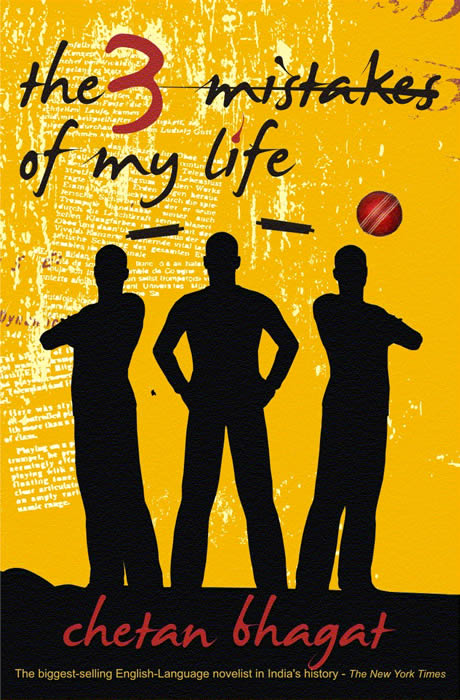
The 3 Mistakes of my life - Chetan Bhagat

India has seen quite a few English writers in the past, from R. K. Narayan known for his simple, yet lively writing to Shashi Tharoor whose breadth and variety has captured people's imagination. Though I wouldn't place Chetan Bhagat in the same league, he has managed to capture a pretty big audience, the youth of India, between 15 and 30 years of age, by targeting his writing to their needs and basing his works on their lifestyle. After a hugely popular "Five Point Someone" and a popular "One Night at the call center", Chetan Bhagat presents his 3rd book, "The 3 mistakes of my life". Having read "One night at the call center", I wasn't very impressed with his writing style nor his "God speak" theme in the book. But I must give credit to his simple writing style, use of appropriate lingo and realistic description of details. I chanced upon this book, it has been a while since I read a book, so I thought this 250-pager story could be breezed through and would also provide me the required warm-up to bootstrap my reading habit again.

This book is a story that delves deep into the life, emotions and aspirations of a young Gujarati businessman. The story is set in the early part of this millenium and covers many news events like the earthquake at Bhuj, the Godhra train incident, India's spectacular series triumph against Australia and the Gujarat communal violence. Chethan Bhagat narrates the Gujarati lifestyle in good detail with emphasis on the psyche of the Gujarati youth. The story is pretty gripping in the second half of the book. Though Brett Lee becomes Fred Li and Modiji is Parekhji, the essence comes through pretty well in the book. On the flip side, the book reminds me of a typical bollywood movie, love story to fight scenes and all the melodrama in between. I wouldn't put this book in the must read category, but do read it if you want a peek into the society one of the most enigmatic states in India, a state flanked with phenomenal progress on one side and communal bias on the other.
Overall, a light read that can be raced through, if you have nothing else to do.

Tuesday, May 27, 2008

The Elephant, the Tiger, & the Cell Phone


For those who are new to Shashi Tharoor's non-fiction work this might be a good start. It is a collection of essays covering a wide range of subjects from politics, ailing sports except for cricket, the rising economy and pluralistic Indian society. It is a good collection of facts, analysis, sprinkled with sometimes subtle but otherwise straight humor. Dr. Tharoor talks about Indianness in the emerging world of globalization. He touches on oddities such as India being at the forefront in adopting technologies like cell phone but still believing strongly in theories of numerology/astrology may be even while choosing a cell number. This is a serious piece of work one might want to read to get in touch with issues, conflicts, advantages and sometimes plain facts about India in the past 10 years.

Here is Shashi Tharoor on his book..


Sunday, March 9, 2008

Neither Here nor There: Travels in Europe -- Bill Bryson

Close friends know I have been bitten by the travel bug ever since I read Eat, Pray, Love. I have been doing the "I need to go to Italy" chant for the past few months. Bill Bryson's 'Neither here nor there' managed to add just about 30 other places to the chant.

The book is Bill's humorous (not always the laugh-out-loud kind of humor, but the amused-grin-evoking kind) recounts of his travel around various cities in Europe.

The thing I liked most about his potrayals of these various places was how he pays so much attention to the people and the culture itself as opposed to the palaces and the museums and the gardens. Personally to me, that is what is most intriguing about a new place.

The narration has the lighthearted tone of a relaxed back-packer taking his time to soak up the essence of a new place. Facts have clearly been exagerrated here and there to achieve a part-comical, part-acerbic flavor - but that is a humorist's license, is it not?

Excerpts:-
--------------------------------------------------------------------------------
The Romans park their cars the way I would if I had just spilled a beaker of hydrochloric acid on my lap.
--------------------------------------------------------------------------------
The problem is that [in Paris] the pedestrian crossing lights have been designed with the clear purpose of leaving the foreign visitor confused, humiliated, and, if all goes according to plan, dead.
--------------------------------------------------------------------------------


Now, for the nit-picking: on the whole, the book gave me the impression that there were more places that displeased him than delighted. A little more cribbing than I would generally choose to hear :).

Otherwise, an apt book for a travel enthusiast in a very ironical way - it leaves you with the feeling that you've had enough reading about it and you just need to take the next flight.

Thanks to Sandeep for lending me the book! :)

Wednesday, February 13, 2008

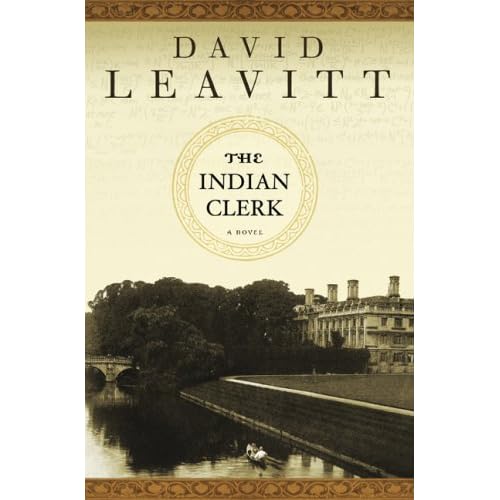
"The Indian Clerk: A Novel" by David Leavitt

The best historical novels -- Gone with the Wind, for example -- make you live history. Immersed in characters, some fictitious, some real, the reader re-imagines the past, filtered through the author's vivid imagination. I was therefore intrigued to hear that David Leavitt was going to write a historical novel about the celebrated relationship between the mathematicians G. H. Hardy and Srinivasa Ramanujan. His new book, The Indian Clerk is not quite a historical novel; at least it is not a good historical novel. It is perhaps accurately described as novelized history. It gives a good account of the four years that Ramanujan spent at Cambridge with Hardy -- an account far more entertaining and fun, than say, a scholarly biography of Ramanujan would be. It is a tepid novel, but a good read.

The story -- of genius found, and lost -- hardly needs re-telling. In January 1913, G. H. Hardy, already famous, and at the height of his powers, received a letter from a man called Ramanujan, a clerk living in Madras, asking for suppport. With the letter are several pages full of mathematics. Hardy, to his credit, a genuine mathematician in those pages. He, and J. E. Littlewood, his collaborator, arranged to have Ramanujan come over to Cambridge. Ramanujan had little formal education, having dropped out of college because losing his scholarship, his obsessive interest in mathematics leading him to neglect all his other subjects. The mathematics he knew was almost all self-taught -- and his lack of knowledge combined with his genius meant that he rediscovered independently many important theorems that others had already discovered before. The collaboration between Hardy and Ramanujan, with Hardy doing his best to channel Ramanujan's genius, was enormously productive although Ramanujan never really adapted to England. Distressed with the food, hampered by the cold, worried about his family back in India -- he left immediately after the war was over. Within the next year, he was dead. He was only 32.

Leavitt tells this story from different perspectives, often in confusing succession. Mostly it is through Hardy, who collaborated closely with Ramanujan but never really took the effort of making him feel at home. Even here, Leavitt switches disconcertingly between telling the story in the third person (with access to Hardy's innermost thoughts) and in the first (as "the lecture Hardy never gave"). We also get the perspective of some other characters: Alice Neville (the wife of the Cambridge Fellow Eric Neville, who, in the book's most overwrought portion, thinks she's in love with Ramanujan), Hardy's sister Gertrude, and G E. Littlewood.

The central theme, the weave that holds these narratives together is the strange effect the arrival of Ramanujan had on these individuals. Leavitt has certainly done a prodigious amount of research and it is a testament to his skill as a writer that he is able to novelize incidents and facts that he has culled from various sources. He is successful in giving a portrait of G. H. Hardy, richly imagining his innermost thoughts. But, and somewhat puzzling, Leavitt leaves Ramanujan alone, and does not even try giving us Ramanujan's version of events. He remains a strange figure, inscrutable, unknown, mysterious. Perhaps that is our duty to genius: novelists may choose to analyze them from the outside, but imagining their inner life is off-limits.

I may perhaps be guilty of wanting Leavitt to write a novel he had no intention of writing. But The Indian Clerk, with its the recycling of events, both true and fictitious, is fun too. What it isn't is transcendent.