Friday, September 5, 2008

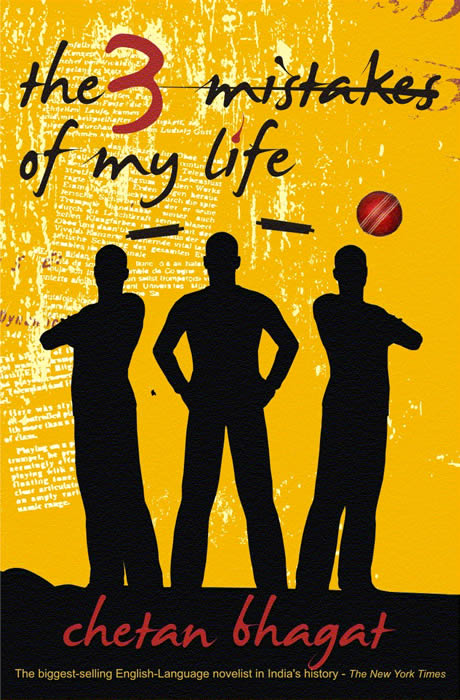
The 3 Mistakes of my life - Chetan Bhagat

India has seen quite a few English writers in the past, from R. K. Narayan known for his simple, yet lively writing to Shashi Tharoor whose breadth and variety has captured people's imagination. Though I wouldn't place Chetan Bhagat in the same league, he has managed to capture a pretty big audience, the youth of India, between 15 and 30 years of age, by targeting his writing to their needs and basing his works on their lifestyle. After a hugely popular "Five Point Someone" and a popular "One Night at the call center", Chetan Bhagat presents his 3rd book, "The 3 mistakes of my life". Having read "One night at the call center", I wasn't very impressed with his writing style nor his "God speak" theme in the book. But I must give credit to his simple writing style, use of appropriate lingo and realistic description of details. I chanced upon this book, it has been a while since I read a book, so I thought this 250-pager story could be breezed through and would also provide me the required warm-up to bootstrap my reading habit again.

This book is a story that delves deep into the life, emotions and aspirations of a young Gujarati businessman. The story is set in the early part of this millenium and covers many news events like the earthquake at Bhuj, the Godhra train incident, India's spectacular series triumph against Australia and the Gujarat communal violence. Chethan Bhagat narrates the Gujarati lifestyle in good detail with emphasis on the psyche of the Gujarati youth. The story is pretty gripping in the second half of the book. Though Brett Lee becomes Fred Li and Modiji is Parekhji, the essence comes through pretty well in the book. On the flip side, the book reminds me of a typical bollywood movie, love story to fight scenes and all the melodrama in between. I wouldn't put this book in the must read category, but do read it if you want a peek into the society one of the most enigmatic states in India, a state flanked with phenomenal progress on one side and communal bias on the other.
Overall, a light read that can be raced through, if you have nothing else to do.

Tuesday, May 27, 2008

The Elephant, the Tiger, & the Cell Phone


For those who are new to Shashi Tharoor's non-fiction work this might be a good start. It is a collection of essays covering a wide range of subjects from politics, ailing sports except for cricket, the rising economy and pluralistic Indian society. It is a good collection of facts, analysis, sprinkled with sometimes subtle but otherwise straight humor. Dr. Tharoor talks about Indianness in the emerging world of globalization. He touches on oddities such as India being at the forefront in adopting technologies like cell phone but still believing strongly in theories of numerology/astrology may be even while choosing a cell number. This is a serious piece of work one might want to read to get in touch with issues, conflicts, advantages and sometimes plain facts about India in the past 10 years.

Here is Shashi Tharoor on his book..


Sunday, March 9, 2008

Neither Here nor There: Travels in Europe -- Bill Bryson

Close friends know I have been bitten by the travel bug ever since I read Eat, Pray, Love. I have been doing the "I need to go to Italy" chant for the past few months. Bill Bryson's 'Neither here nor there' managed to add just about 30 other places to the chant.

The book is Bill's humorous (not always the laugh-out-loud kind of humor, but the amused-grin-evoking kind) recounts of his travel around various cities in Europe.

The thing I liked most about his potrayals of these various places was how he pays so much attention to the people and the culture itself as opposed to the palaces and the museums and the gardens. Personally to me, that is what is most intriguing about a new place.

The narration has the lighthearted tone of a relaxed back-packer taking his time to soak up the essence of a new place. Facts have clearly been exagerrated here and there to achieve a part-comical, part-acerbic flavor - but that is a humorist's license, is it not?

Excerpts:-
--------------------------------------------------------------------------------
The Romans park their cars the way I would if I had just spilled a beaker of hydrochloric acid on my lap.
--------------------------------------------------------------------------------
The problem is that [in Paris] the pedestrian crossing lights have been designed with the clear purpose of leaving the foreign visitor confused, humiliated, and, if all goes according to plan, dead.
--------------------------------------------------------------------------------


Now, for the nit-picking: on the whole, the book gave me the impression that there were more places that displeased him than delighted. A little more cribbing than I would generally choose to hear :).

Otherwise, an apt book for a travel enthusiast in a very ironical way - it leaves you with the feeling that you've had enough reading about it and you just need to take the next flight.

Thanks to Sandeep for lending me the book! :)

Wednesday, February 13, 2008

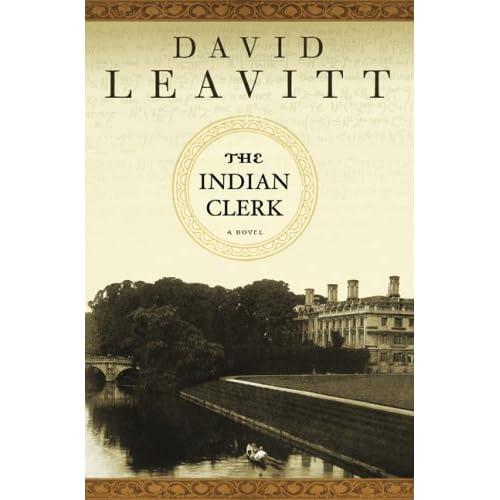
"The Indian Clerk: A Novel" by David Leavitt

The best historical novels -- Gone with the Wind, for example -- make you live history. Immersed in characters, some fictitious, some real, the reader re-imagines the past, filtered through the author's vivid imagination. I was therefore intrigued to hear that David Leavitt was going to write a historical novel about the celebrated relationship between the mathematicians G. H. Hardy and Srinivasa Ramanujan. His new book, The Indian Clerk is not quite a historical novel; at least it is not a good historical novel. It is perhaps accurately described as novelized history. It gives a good account of the four years that Ramanujan spent at Cambridge with Hardy -- an account far more entertaining and fun, than say, a scholarly biography of Ramanujan would be. It is a tepid novel, but a good read.

The story -- of genius found, and lost -- hardly needs re-telling. In January 1913, G. H. Hardy, already famous, and at the height of his powers, received a letter from a man called Ramanujan, a clerk living in Madras, asking for suppport. With the letter are several pages full of mathematics. Hardy, to his credit, a genuine mathematician in those pages. He, and J. E. Littlewood, his collaborator, arranged to have Ramanujan come over to Cambridge. Ramanujan had little formal education, having dropped out of college because losing his scholarship, his obsessive interest in mathematics leading him to neglect all his other subjects. The mathematics he knew was almost all self-taught -- and his lack of knowledge combined with his genius meant that he rediscovered independently many important theorems that others had already discovered before. The collaboration between Hardy and Ramanujan, with Hardy doing his best to channel Ramanujan's genius, was enormously productive although Ramanujan never really adapted to England. Distressed with the food, hampered by the cold, worried about his family back in India -- he left immediately after the war was over. Within the next year, he was dead. He was only 32.

Leavitt tells this story from different perspectives, often in confusing succession. Mostly it is through Hardy, who collaborated closely with Ramanujan but never really took the effort of making him feel at home. Even here, Leavitt switches disconcertingly between telling the story in the third person (with access to Hardy's innermost thoughts) and in the first (as "the lecture Hardy never gave"). We also get the perspective of some other characters: Alice Neville (the wife of the Cambridge Fellow Eric Neville, who, in the book's most overwrought portion, thinks she's in love with Ramanujan), Hardy's sister Gertrude, and G E. Littlewood.

The central theme, the weave that holds these narratives together is the strange effect the arrival of Ramanujan had on these individuals. Leavitt has certainly done a prodigious amount of research and it is a testament to his skill as a writer that he is able to novelize incidents and facts that he has culled from various sources. He is successful in giving a portrait of G. H. Hardy, richly imagining his innermost thoughts. But, and somewhat puzzling, Leavitt leaves Ramanujan alone, and does not even try giving us Ramanujan's version of events. He remains a strange figure, inscrutable, unknown, mysterious. Perhaps that is our duty to genius: novelists may choose to analyze them from the outside, but imagining their inner life is off-limits.

I may perhaps be guilty of wanting Leavitt to write a novel he had no intention of writing. But The Indian Clerk, with its the recycling of events, both true and fictitious, is fun too. What it isn't is transcendent.

Monday, January 28, 2008

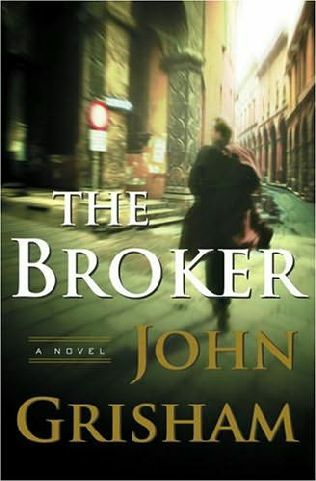
The broker

Although this is a fairly old book of Grisham's, I got around to reading it only now. The broker is the story of a cunning Washington lawyer and lobbyist, who amasses money and power by hook and crook. One of his crooked deals gets him between a rock and a hard place. With multiple foreign secret services after his life, he cuts a deal, pleads guilty and gets into federal prison.

The twists begin when the CIA lets him loose with a presidential pardon, so that he can be bait. The CIA wants to know who will come after / kill him. They throw him in Italy in a totally foreign environment and leak his presence.

The real fun begins when the FBI and the CBI get into loggerheads, trying to one-up each other. Backman's cunningness comes to the fore, when he escapes multiple assassins, comes back to Washington and plays the political establishment to clean his life.

An engrossing read, left me on a high. I found it funny though, how Grisham calls it 'hacking', when a user uses an internet cafe to send email. The other references to technology like the smart phones, encrypted email etc all sound quite realistic though.

Would recommend this.

Thursday, January 17, 2008

"Dreaming in Code" by Scott Rosenberg

Scott Rosenberg's "Dreaming in Code", despite its rather evocative title, is the mundane story of an ongoing software project called "Chandler", a tool for Personal Information Management (PIM). Wait, that's not right. It is a vividly written but altogether-familiar story of software development. A story of requirements ("specs") and disagreements, of delays and deadlines, of plans, of changes in plans and of more changes in plans, of ideals and of pragmatism, and of course, of bugs that make you tear your hair out in agony. The sort of things that are all too familiar, when it comes to coding.

Why then, was it written? Over to Rosenberg :
Chandler offered a look at the technical, cultural and psychological dimension of making software, liberated from the exigencies of the business world. [pg 54]
But I am getting ahead of my tale.

In the post-war era, a project that took on a special meaning with the development of computing machines: the augmentation of human intellect. Here, many people thought, was a tool to rival language, and writing, a tool perhaps to re-invent man himself. The vision has been expressed eloquently: most notably by Vannevar Bush ("As We May Think") and Douglas Engelbart ("Augmenting Human Intellect"). Chandler, an open-ended open-source project, follows in that same tradition.

Mitchell Kapor, the owner of OSAF, and the hero of our story, was the designer behind Lotus 1-2-3, the first widely successful spreadsheet used in the business world. Lotus 1-2-3 made Kapor a millionaire several times over. His next product called "Agenda", was supposed to take personal information management to the next level and from the reviews, it did! -- but it never really took off and Lotus dropped it like a hot potato (see this review by James Fallows, that praises Agenda but also gives a good idea of its difficulties). But Agenda remained on Kapor's mind and in Chandler, he tried to go back to the same feeling that inspired him to build it.

What was this spirit? PIMs like Microsoft Outlook separate their content into silos: there's email, there are tasks, there are lists, there are action items, and so on. But of course there are no such neat categories in human activity where everything is also something else. My email is also a task (not the least because I actually have to type a reply to it), a task or a project involves emails, emails are parts of projects, emails are a way to store and access files, documents. In other words, the decomposition of the artifacts of human activity, while convenient, is also just that: an analytic convenience. Agenda aimed to go beyond silos -- as does Chandler. A personal tool that would not be caught into silos, something that could truly capture the way humans actually worked, and thereby help them do their tasks better.

Of course, all this is easier said than done. Programming itself is all about silos. Formalization, which is after all what programs are all about, require us to logically decompose processes and methods into categories. The better the categories are defined, the better a program will work. Overlapping categories and amorphous boundaries, while not unimplementable, are almost guaranteed to break down in some scenario or the other. Still, Chandler was almost a romantic project, a project that followed in the tradition of Bush and Engelbart so it had an open-ended vision, something most software projects can't really afford.

That Chandler could do so was because it was administered by Kapor's OSAF, the Open Source Applications Foundation. This was to be a non-profit project, a project solely instigated by what is called "the programmer's itch", an urge to get something done that starts off with a personal wish or frustration ("I wish I had a software that did this" or "Damn, why can't this calendar software do that??" etc). The non-profit part (which of course depended heavily on Mitch Kapor's deep pockets) meant that the Chandler team was liberated from constraints that come when you program for profit.

But there was a third component that made Chandler special. Chandler was to be open-source and therefore it was meant to harness the forces of peer production. This meant that a core Chandler team would work on the code, while at the same time, at least in theory, relying on a vast array of programmers all over the world. In short it would take the best of the two modes of production, made famous by Eric Raymond: "the Cathedral and the Bazaar". In his essay, Raymond postulates that there are two modes of production. One of them, embodied by the cathedral, is a top-down, command-and-control approach, where a plan is built up and then systematically carried out. The other, embodied by the bazaar, is bottom-up: a group of people find each other and self-organize, without any command-and-control structure. The development of Linux followed the bazaar model -- and the main reason for its success that the internet offered a wide range of tools for a lot of people, all over the world, to collaborate. Raymond's conclusion is what he called Linus' Law: "Given enough eyeballs, all bugs are shallow".

So, did Chandler's combination of the cathedral and the bazaar work? Its still too early to tell, Rosenberg's book ends with the release of Chandler 0.5 (the most recent version is 0.7 -- the fully functional Chandler release is 1.0, still a long way off). But the book does illustrate the problems of having an open-ended software project. Because the Chandler team could not agree on a set of requirements, they could not get a batch of workable code out immediately -- the release of workable code being a crucial component in harnessing the forces of peer production. But Chandler never quite managed to get the participation that a peer-produced project generally needs and slowly its team slogged on, making compromises, slowly and steadily.

I could go on and on but I'll stop now. Try Chandler out, I liked it, even if I don't quite visualize using it just yet. What did I take away from Dreaming in Code? Perhaps, if nothing else, this quote by Linus Torvalds, his advice for people starting large open-source projects, burned into my brain (pg 174):

"Nobody should start to undertake a large project, " Torvalds snapped. "You start with a small trivial project, and you should never expect it to get large. If you do, you'll just overdesign and generally think it is more important than it likely is at that stage. Or, worse, you might be scared away by the sheer size of the work you envision. So start small and think about the details. Don't think about some big picture and fancy design. If it doesn't solve some fairly immediate need, it's almost certainly overdesigned."

Words from the wise, indeed.
Sunday, January 13, 2008

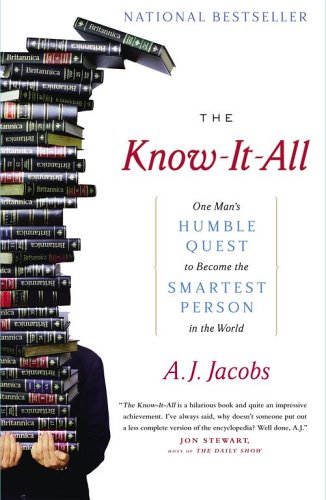
The Know-It-All: One Man's Humble Quest to Become the Smartest Person in the World -- A.J. Jacobs

A.J. Jacobs decides to go through the daunting task of reading all 32 volumes (32,900 pages) of the Encyclopaedia Britannica and does! The result - this book, a compilation of strange, very interesting facts associated with each word he reads, augmented by his own sarcastic humor about the fact and intertwined with funny events in his life, mostly around his quest for knowledge.


Excerpts:-
--------------------------------------------------------------------------------
oyster
Oysters can change sex according to the termperature of the water. I always knew there was something emasculating about warm baths.
--------------------------------------------------------------------------------
punctuation
The Greek interrogation mark became the English semicolon. Bizarre, no;
--------------------------------------------------------------------------------
katydid
This member of the grasshopper family is named for its unique mating call, which sounds like a psychotic witness: "Katy did, Katy didn't, Katy did, Katy didn't."
--------------------------------------------------------------------------------
death
A Russian nobleman patented a coffin that allowed the corpse-if he regained consciousness after burial-to summon help by ringing a bell. A good idea. Because that could really screw up your week-to wake up and fine yourself in an airless coffin. I guess nowadays they could put cell phones in there.
--------------------------------------------------------------------------------

An encyclopedia with fun oddball facts. Would make for a nice coffee table book too, given you can turn to any page and spend just a couple minutes to be entertained and informed.

Tidbit: Some other people who have read the entire Britannica: Isaac Asimov, Richard Feynman, C. S. Forester and George Bernard Shaw.